
- Azione tragica in 2 acts
- Composer: Gioachino Rossini
- Libretto: Andrea Leone Tottola, after Racine’s Andromaque (1667)
- First performed: Teatro di San Carlo, Naples, 27th March 1819
Characters
| ERMIONE (Hermione), daughter of Helen and Menelaus | Soprano | Isabella Colbran |
| ANDROMACA (Andromache), widow of Hector | Contralto | Benedetta Rosmunda Pisaroni |
| PIRRO (Pyrrhus), son of Achilles and king of Epirus | Tenor | Andrea Nozzari |
| ORESTE (Orestes), son of Agamemnon | Tenor | Giovanni David |
| PILADE (Pylades), Oreste’s companion | Tenor | Giuseppe Ciccimarra |
| CLEONE, Ermione’s confidante | Mezzo | Maria Manzi |
| FENICIO, Pirro’s tutor | Bass | Michele Benedetti |
| CEFISA, Andromaca’s confidante | Contralto | Raffaella De Bernardis |
| ATTALO, Pirro’s confidant | Tenor | Gaetano Chizzola |
| ASTIANATTE (Astyanax), Andromaca’s son | Silent | |
| Lords of Epirus; Trojan prisoners; Oreste’s attendants; Spartan maidens |
Setting
Buthrote, capital of the kingdom of Epirus; soon after the Trojan War
I wrote the bulk of this review four years ago, but didn’t publish it. The combination of Ermione and Semiramide (nearly four hours of empty commonplaces and flashy vocal display) brought a series of reviews of Rossini to a halt. It’s strange; Rossini was once one of my favourite composers – after Gounod’s Faust and Mozart (Don Giovanni), he was the first I fell in love with. While I still enjoy his comic operas, increasingly I find his serious operas frustrating. Tastes change over 20 years.
Ermione has never been popular. Rossini’s fifth opera for the Teatro San Carlo, it left audiences indifferent or disconcerted. French critics like Blaze de Bury and the Escudier brothers (none of whom heard the work) thought Ermione was an attempt to change genre and introduce the declamatory style of French tragédie lyrique or Gluck to Italian opera – not something likely to please Neapolitan ears, particularly when the only emotion in the work is anger.
Newspapers did not review the work – a tacit decision not to criticize what they considered one of Rossini’s misfires. Rossini withdrew the score after only seven performances (the last two of the first act only) – a poor run compared to the successes of Mosè in Egitto or Ricciardo e Zoraide (both 1818). He recycled some of the passages for the pastiche Eduardo e Cristina (1819) and for Ugo re d’Italia, a work planned for London that never eventuated.
Decades later, Rossini was asked if he would allow Ermione to be translated for the French stage. “No,” he replied; “this is my little Italian Guillaume Tell, and it won’t see daylight again until after my death.” Daylight came almost 160 years later, at a concert performance for Siena in 1977; the first modern staging followed a decade later, at Pesaro in 1987.
These days, Ermione is considered one of Rossini’s great achievements: Philip Gossett, editor of the critical edition, calls it “one of the finest works in the history of 19th-century Italian opera”. Bruno Cagli (Erato CD) considers it the most structurally original of Rossini’s works; the composer rejects self-contained numbers in favour of more extended musico-dramatic forms, culminating in Ermione’s gran scena in Act II, an enormous aria that takes up much of the act.
The opera takes place in Epirus shortly after the Trojan Wars. The king, Pirro, son of Achilles, has fallen in love with his prisoner Andromaca, widow of Hector. His jilted lover, Ermione, daughter of Menelaus, seeks revenge, and goads her cousin Oreste, son of Agamemnon, to murder her faithless lover. But Ermione was half-mad with rage when she gave Oreste the dagger; she curses him, then collapses.
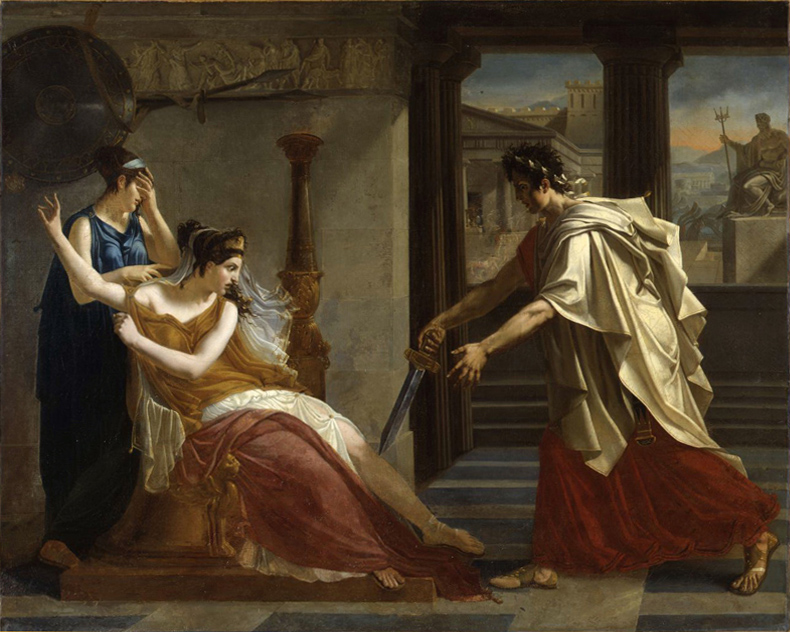
Ermione is one of Rossini’s most dramatic works – a study in erotic obsession erupting in murder – but it’s also easy to see why early audiences rejected it. The opera’s innovations are at a structural level rather than a melodic one (hence its appeal to musicologists rather than theatre audiences). While there are fine things in it, there is also far too much that is conventional or formulaic.
Barring an ensemble in the Act I finale, there are few of the glorious concerted numbers we find in other Rossini works of the period, and that redeem weaker works like Ricciardo. Rossini’s operas are vehicles for singers rather than musico-dramatic conceptions; unlike French or German operas of the time, there is little attempt to give an opera individuality. There is no couleur locale, no distinctive musical or harmonic palette; but we find all too familiar musical and rhythmic formulae and orchestration. Rossini’s operas sound the same; many contain brilliant things – which is very different from saying they are brilliant operas – but to listen to a dozen in a row is, as Dent said, a depressing experience.
The overture encapsulates this queasy mixture of originality and convention. The overture is interrupted by a choral lament for Troy (reprised in the opening) – an unprecedented gesture – but this is coupled with a crescendo straight out of The Barber of Seville.
The foreboding mood of the lament continues into the Introduzione (No. 1: ‘Troia! qual fosti un dì!’), which takes place in the dungeon where the Trojan prisoners are held captive, among them Andromaca’s son Astyanax. The chorus of Phrygian captives (an andante in B minor) is sombre and powerful; Andromaca’s aria to her son (andantino in B major) a tender, long-breathed, almost Bellinian melody. Now that Hector is dead, the Trojan princess lives only for her son; Pirro, though, wants to marry her.
Outside the palace; dawn. Spartan maidens invite Ermione to hunt, but her heart is full of revenge and jealousy; the slave Andromaca has robbed her of Pirro’s love. The Spartan chorus (No. 2: ‘Dall’Oriente’) is a lively allegro vivace in C major. Ermione reproaches Pirro for his fickleness in a long, rather predictable duet (No. 3: ‘Non proseguir! comprendo’).
Throne room. Oreste arrives as Greek ambassador; he may be a poor choice, since passion for Ermione governs him, despite his friend Pylade’s counsel to be reasonable. Oreste’s cavatina (No. 4: ‘Reggia abborita!’) becomes a quasi-duet with his companion. A rather dreadful March (No. 5), with banda onstage, announces the arrival of Pirro and his court. Oreste demands the king hand over the son of Hector to be killed; he may avenge his father and Troy. Pirro refuses (No. 6: Aria: ‘Balena in man del figlio’); the Greeks may even see Astyanax share his throne.
Outside the palace (as in Scene II). Andromaca, however, has rejected Pirro’s offer of marriage. To spite her, he gives his hand to Ermione, and will hand Astyanax over to the Greeks. Just as they are about to take the boy, Andromaca asks for more time; Pirro, delighted, rejects Ermione yet again. The finale contains a lovely andantino nonet (‘Sperar…Temer…’) and a furious stretta (“Pirro, deh serbami”).
Act II– Entrance hall of palace. The ac begins with a duet for Andromaca and Pirro (No. 8: ‘Ombra del caro sposo!’). She consents to marry Pirro; he orders the wedding to be held immediately, and Astyanax to be treated as his own son. The Trojan, however, will make Pirro swear to protect her son, then kill herself, true to Hector. Now comes Ermione’s gran scena (No. 9: ‘Essa corre al trionfo!’), an enormous, multi-section aria (vivace – andantino – allegro – andante – moderato – allegro), punctuated by wedding procession and chorus; she gives Oreste the dagger; horrified, he takes it and leaves. The scene is clearly inspired by Cherubini’s Médée. A rather boring duettino for Pilade and Fenicio (No. 10: ‘A così trista immagine’) lowers the emotional temperature.
Final scene (No. 11: ‘Che feci? … dove son?’): Oreste returns, and describes how he murdered Pirro, to an inappropriately chirpy rhythm. Cue duet with Ermione, finale, etc.
May I suggest Grétry’s Andromaque instead?
(See also my pal Phil’s review.)
Recordings
Listen to: Cecilia Gasdia (Ermione), Margarita Zimmermann (Andromaca), and Chris Merritt (Oreste), with the Orchestre Philharmonique de Monte-Carlo, conducted by Claudio Scimone, 1986. Erato Records.
Watch: Anna Caterina Antonacci (Ermione), Diana Montague (Andromaca), and Bruce Ford (Oreste), with the London Philarmonic Orchestra, conducted by Andrew Davis, Glyndebourne, 1995. Warner Music Vision.
 The Opera Scribe
5 thoughts on “272. Ermione (Rossini)”