
- Romantische Oper in 3 acts
- Composer: Richard Wagner
- Libretto: Based on Carlo Gozzi’s dramatic fairytale La Donna Serpente
- First performed: Königliches Hof- und National-Theater, Munich, Germany, 29th June 1888, conducted by Franz Fischer
Characters
| DER FEENKÖNIG [the Fairy King] | Bass | Victorine Blank |
| ADA, a fairy | Soprano | Lili Dressler |
| FARZANA and | Soprano | Marie Sigler |
| ZEMIRA, fairies | Soprano | Pauline Sigler |
| ARINDAL, King of Tramond | Tenor | Max Mikorey |
| LORA, his sister | Soprano | Adrienne Weitz |
| MORALD, her betrothed, and Arindal’s friend | Baritone | Rudolf Fuchs |
| GERNOT, Arindal’s huntsman | Buffo bass | Gustav Siehr |
| DROLLA, Lora’s maid | Soprano | Emilie Herzog |
| GUNTHER, at the court of Tramond | Buffo tenor | Heinrich Herrmann |
| HARALD, Arindal’s general | Bass | Kaspar Bausewein |
| Arindal and Ada’s children, a boy and a girl | ||
| A Messenger | Tenor | Max Schlosser |
| The voice of the wizard Groma | Bass | |
| Fairies Morald’s companions The people Warriors Underground spirits Bronze men Groma’s invisible spirits | Chorus |
Setting: A fairy garden. A wild wasteland with rocks. Arindal’s kingdom. A terrible wilderness, high wooded rocks. A terrible, underground chasm. A Magnificent fairy palace, crossed by clouds.
At the end of his life, Wagner disowned Die Feen. He did not think that its score, or that of other “youthful works or compositions of circumstance, which did not arise from the most sublime occasions”1, should be published.
Die Feen, modelled on Beethoven and Weber (and Marschner), was the sort of work his music dramas had superseded: a German Romantic opera, clearly divided into Quartets and Trios, and full of coloratura vocalises. If Tristan or the Ring were artworks of the future, this belonged to the distant past. It was a far cry from the weighty, five-hour works about redemption through love, fools through compassion knowing, daylight sinking into death, wounds, Grails, and swans.
Die Feen, which Wagner wrote at the age of 20, while working as a part-time chorus master in Würzburg, was his fourth attempt at an opera; the others (including a gruesome story about a bride who pushes her husband off a parapet on their wedding night) he had abandoned or destroyed because his family disapproved. This time, he adapted a fairy story by Gozzi – a choice he hoped would please his family (particularly his uncle, who had translated Gozzi into German).
The story, like so many of Wagner’s later operas, is high fantasy. Eight years before the story opens, King Arindal of Tramond went hunting, and shot a deer – or, rather, the fairy Ada, who had taken the guise of a deer. Putting aside all thoughts of venison, or of making a quick buck from the doe, Arindal married the fairy. Now, however, Ada has a grim choice: she must test her husband’s faith in her; if he fails, he will go mad and die, and she will be turned to stone for a century. Oh deer, one might say. (It is very much a model for Richard Strauss’s Frau ohne Schatten.) Ada kills half Arindal’s soldiers, and throws his children into a fiery abyss. For some reason, he finds this irksome, and curses his wife. The misfortune that Ada had feared comes true; she is transmogrified, and becomes a boulder in an underground cavern. Like Orpheus in quest of Eurydice, however, Arindal sets out to rescue his wife; he overcomes monsters and passes ordeals. The pair are reunited, Arindal is granted immortality, and he and Ada live happily ever after.
“I painted this subject with the utmost colour and variety,” Wagner recalled in My Life2. “In contrast to the lovers out of fairyland, I depicted a more ordinary couple, and I even introduced a third pair that belonged to the coarser and more comical servant world. I purposely went to no pains in the matter of the poetic diction and the verse. My idea was not to encourage my former hopes of making my name as a poet; I was now really a ‘musician’ and a ‘composer’, and wished to write a decent opera libretto simply because I was sure nobody else would write one for me; the reason being that such a book is something quite unique and cannot be written either by a poet or by a mere man of letters.”
Wagner’s brother Albert, a singer, however, judged it unsuitable for performance: “You may be able to get it done, but you will have a lot of trouble with the singers.” Nevertheless, Wagner performed some of the ‘numbers’ from the opera at concerts in Würzburg, and thought they were “favourably received”. Die Feen was accepted for performance in Leipzig in 1833, but the director, Hauser, changed his mind; it was not classical enough. A decade later, when Wagner wrote his “Autobiographical Sketch”, that broken promise still rankled. “I was soon forced to the same experience that every German composer has nowadays to win: we are discredited upon our native stage by the success of Frenchmen and Italians, and the production of our operas is a favour to be cringed for. The performance of my Feen was sat upon the shelf.”3 Never staged in Wagner’s lifetime, it was first produced in 1888, five years after the composer’s death, thanks to the efforts of Richard Strauss.
Die Feen is promising, but hardly great; at 3 ¼ hours, it is a long work, and one of very uneven inspiration. Its chief merit is to show Wagner assimilating the German styles of his time; in his next two operas, he would assimilate French opéra-comique, grand opéra, and Italian styles – and then discard them in the music dramas of the 1860s. There is some basic use of motifs – one associated with Ada (plugged in the overture) – but Wagner still thinks far more in terms of the voice than of the orchestra; there is some florid coloratura for the soprano, and even several a cappella passages. Worryingly, too, Wagner shows his enthusiasm for inflicting extremely long, static monologues on the audience. Themes recur in later works, especially Lohengrin: the marriage of a mortal and an immortal, the need to trust a spouse, even the detail of cutting off a magician’s finger, while Arindal’s lyre-strumming in Act III anticipates Tannhäuser. And we meet a couple of characters called Gunther and Morold.
The opera begins with a stately overture in E flat, rising to a very Germanic passion. Act I opens in a fairy garden – with, of all things, a ballet, dainty fairies tripping hither, tripping thither. (The horns are rather nice.) There is an excellent chorus: “Ihr Feen all!” Too much of the act is taken up by lengthy exposition and dull ensembles; Wagner, never the most efficient of stage dramatists, struggles to keep his story moving. Arindal’s aria “Wo find ich dich, wo wird mir Trost?” features protracted recitative, and seems awkwardly written for the voice. Nor is Gernot’s romance (another long narrative) enthralling. The act’s centrepiece is a quartet, in which Arindal’s friends, disguised as a priest and his father’s ghost, try to warn him against Ada’s magic; thunder and lightning reveal their original appearance. It is a choppy piece, and makes little impression, despite the Sturm und Drang. Arindal has a couple of virile phrases near the end, however.
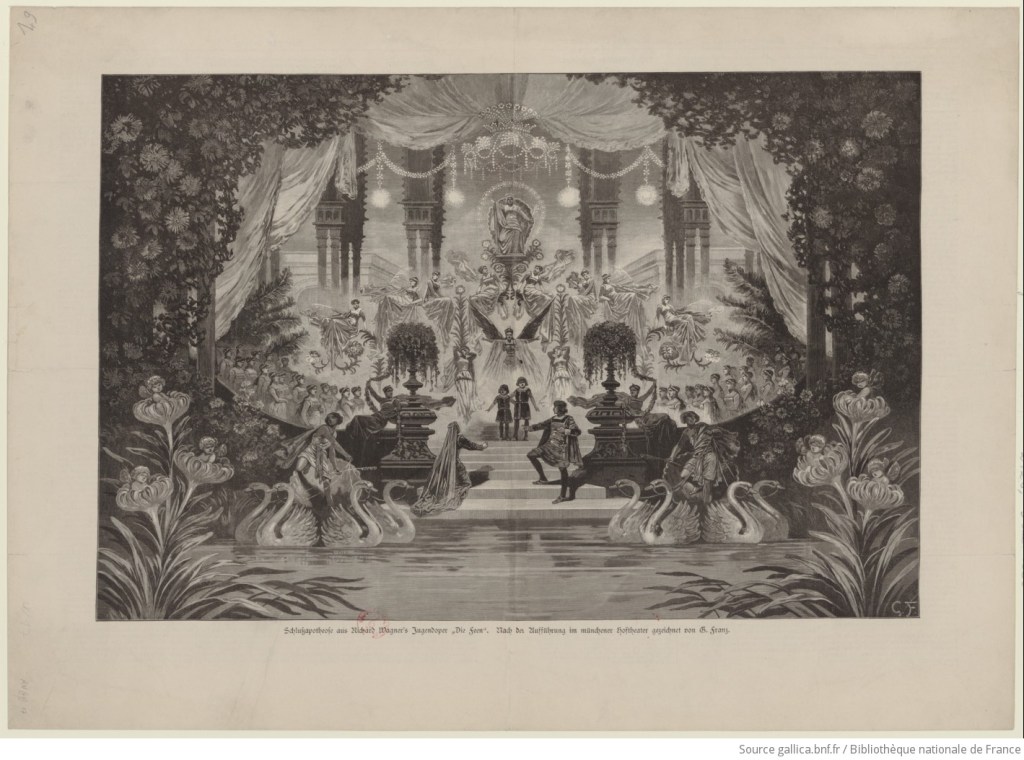
As Arindal falls asleep, accompanied by quite pleasant music, the scene transforms into a fairy garden. Ada, adorned in fairy jewellery, emerges from a magnificent palace, and delivers an Italianate entrance aria, with a plaintive larghetto, lamenting the tests she and her husband will soon face. After a duet between husband and wife, a procession of fairies acclaim Ada as queen; her father, the fairy king, has died. Arindal swears an oath not to curse Ada, whatever he may see; the ominous nature of the vow unsettles her, however. The finale comprises a graceful adagio, a majestic allegro maestoso, and a spirited allegro di molto.
Act II takes place in Arindal’s kingdom, besieged by enemies after his eight-year absence. An effective chorus of warriors and citizens (allegro agitato) sets the scene. Arindal’s sister Lora has acted as regent; she sings a two-part aria, “O must du Hoffnung schwinden” – conventional, but enlivened by a fun cabaletta. Lora, Arindal, and Morald’s trio, while acceptable, seems to lack a distinct idea. Drolla and Gernot’s duet, modelled on Papageno/a in Mozart’s Zauberflöte, is one of the few humorous moments in Wagner. Ada’s scene and aria – a 10-minute monologue – is notable for its length rather than its musical or theatrical merit; the allegro molto e con foco section is at least dramatic. Wagner thought the finale of the second act promised a good effect. A turbulent chorus of townsfolk announce the enemy’s attack. Ada hurls her children into the abyss, to which the others react with horror. A messenger reveals that Ada has destroyed a troop of Arindal’s warriors. This last betrayal is too much; Arindal curses her. Ada reveals that she tricked her husband – the children are safe, the soldiers were traitors, and the day has been won – but it is too late for their love. Arindal goes mad, and Ada sinks out of sight, amidst thunder and lightning, leaving the rest to celebrate their triumph over the invaders.
Act III: As the king’s wits are disordered, Morald and Lora now reluctantly rule. In an a cappella quintet, “Allmächtiger, in deinen Himmel”, all pray for the king’s sanity; it shows Wagner’s skill at writing churchy music in the tradition of Bach. Arindal, now mad, comes on; he hallucinates and thinks he is hunting the deer that is his wife. The offstage voice of the wizard Groma sounds like an echo of the 18th century. Two fairies restore the king’s befuddled wits; secretly hoping for his demise, they agree to lead Arindal to Ada. The trio itself is perfunctory. The finale occurs in a cavern guarded by earth sprites and bronze men. (Their choruses are in the style of Marschner.) Arindal defeats them with a sword and a shield, then, like Tannhäuser, plays his lyre to liberate Ada, showing the power of music and love. The fairy king (I thought he was dead?) grants Ada immortality. The opera ends with an attractive chorus, “Ein hohes Los hat er errungen”.
Recordings
Listen to: April Cantelo (Ada), John Mitchinson (Arindal), and Della Jones (Farzana), with the BBC Northern Symphony Orchestra, conducted by Edward Downes, Manchester, 1974.
Works consulted
- Richard Wagner, My Life, authorised translation, London: Constable, 1963.
- Richard Wagner, “Autobiographical Sketch”, in Wagner on Music and Drama, trans. H. Ashton Ellis, New York: Dutton, 1964.
- Sir W. H. Hadow, Richard Wagner, London: Thornton Butterworth, 1934.
- Robert L. Jacobs, The Master Musicians Series: Wagner, London: J. M. Dent & Sons, 1974.
- Egon Voss, “Die Feen: An Opera for Wagner’s Family”, accompanying Die Feen, conductor Wolfgang Sawallisch, Orfeo.
- See also: Phil’s Opera World
 The Opera Scribe
3 thoughts on “277. Die Feen (Wagner)”