
- Dramma in 3 acts
- Composer: Umberto Giordano
- Libretto: Luigi Illica
- First performed: La Scala, Milan, 19th December 1903, conducted by Cleofonte Campanini
| STEPHANA | Soprano | Rosina Storchio |
| VASSILI | Tenor | Giovanni Zenatello |
| GLEBY | Baritone | Giuseppe De Luca |
| WALITZIN | Bass | Vittorio Pozzi-Camola |
| NIKONA | Mezzo | Palmira Maggi |
| The Girl | Soprano | Emma Trentini |
| ALEXIS | Tenor | Oreste Gennari |
| The Cossack | Tenor | |
| The Banker Miskinsky | Baritone | Antonio Pini-Corsi |
| Lo Starosta | Baritone | |
| The Invalid | Baritone | |
| IVAN | Tenor | Emilio Venturini |
| The Sergeant | Tenor | |
| Ipranivick | Tenor | Federico Ferraresi |
| The Captain | Bass | |
| The Inspector | Bass |
SETTING: Act I: St. Petersburg, in the first half of the 19th century. In August, at dawn on the Feast of Saint Alexander.
Act II: At the border between Siberia and Russia. The halfway point from Omsk to Kolyvan. In winter.
Act III: In a “House of Penitence” in the mines of Trans-Baikal, on the eve of Russian Easter.
Five years after Fedora (1898), Giordano returned to Russia. Both operas begin in a St. Petersburg apartment, and end with the death of the heroine in her lover’s arms, but the tone of each work is a striking contrast: Fedora, based on Sardou, is elegant and cosmopolitan, its leading lady a princess, its characters noble or Nihilist; Siberia is a grim tale of prison camps and suffering.
Stephana is a kept woman, the mistress of Prince Alexis Frouwor, but she loves Vassili, an army officer, who believes she is a working girl. An honest working girl. Vassili – this being opera – is the godson of Stephana’s servant; when he discovers the truth, he mortally wounds Alexis, and is sentenced to prison in Siberia. Stephana follows him there, determined to share his exile and his hardship. Also sentenced to Siberia, however, is Glèby, the pimp who sold Stephana to Alexis; in his jealousy, he first reveals Stephana’s past to Vassili, then betrays their attempt to escape through a disused mine. In the fracas, the guards shoot Stephana.
In the style of the time, the opera is more like a drama set to music than a numbers opera. Giordano is always sensitive to words, and the orchestration is atmospheric, but the melody is often short-breathed and unmemorable; it is lyrical but formless. There is a generic quality to much of verismo opera; Giordano, Puccini, Cilea, whoever, all tend to sound rather the same.
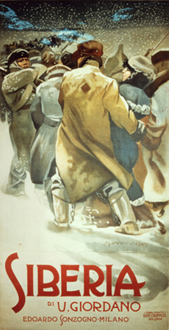
Siberia has been called the most authentically Russian of all Italian operas1, and Giordano skilfully exploits Russian folk music. Act I begins with an unaccompanied chorus of mujiks (tenors and basses), singing melancholily – an effective way of immediately establishing a Russian flavour. Later, Giordano uses the Imperial anthem “Slav’sya”; the Song of the Volga Boatmen for the chorus of the ‘Living Chain’; and the song “Ou vast” (heard in Tchaikovsky’s 1812 Overture), while the final scene uses balalaika music. It’s not original, but it intelligently serves the dramatic purpose.
No doubt Siberia would well on stage; there is much in it that is scenic: pedlars wait for the prisoners, a little girl and her brother hope to see their father one last time; Stephana arrives in a troika drawn by three horses; Easter in the prison camp, governor and prisoners kissing each other, exalted by faith, as bells ring out, at twilight.
Siberia was Giordano’s favourite of his own operas. It featured the same cast as Puccini’s Madama Butterfly, whose première had been postponed due to the composer’s motor accident. It was performed in Paris in 1905; Fauré (Figaro) thought that Act II would “take its place among the most unique and captivating pages that modern dramatic music can offer”2, while Fourcaud (Gaulois) considered it “the frankest and most robust” of all the recent Italian operas3. New York saw it in 1908 and Vienna in 1911. Giordano revised it for La Scala in 1927, after which it largely seems to have vanished from the repertoire.
Other operas set in Siberia include Boieldieu’s Béniowsky, ou les Exilés du Kamchatka (1800), and Donizetti’s Otto mesi in due ore ossia Gli esiliati in Siberia (1827).
See also Phil’s Opera World.
Recordings
Listen to: Luisa Maragliano (Stephana), Amadeo Zambon (Vassili), Laura Londi (Nikona), and Walter Monachesi (Glèby), with the Chorus and Orchestra of RAI, Milano, conducted by Danilo Belardinelli, 1974.
- Robert Raphael, notes accompanying 1974 Belardinelli recording. ↩︎
- Quoted in Le Monde artiste, 14 May 1905 : « Je ne crois pas trop dire en affirmant que ce second acte de Siberia prendra certainement place parmi les pages les plus singulières et les plus captivantes que puisse offrir la musique dramatique moderne. » ↩︎
- Ibid: « « la plus franche et la plus drue » de toutes les partitions jouées ces dernières années sur les scènes de la péninsule… » ↩︎
 The Opera Scribe