
- Drame lyrique in 3 acts
- Composer: Alfred Bachelet
- Libretto: Charles Méré
- First performed: Académie Nationale de Musique, Paris, 6 May 1914, conducted by André Messager
Characters
| LAZARO, called Lo Scemo (The Madman) | Tenor | Aitchewsky |
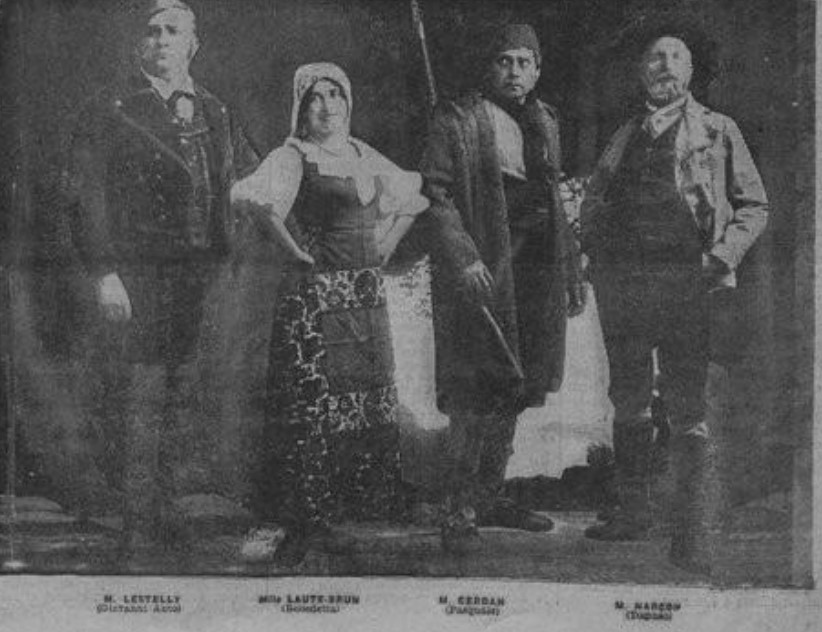
| GIOVANN’ANTO | Baritone | Louis Lestelly |
| ARRIGO DI LECA | Bass | André Gresse |
| TOMASO | Bass | Armand Narçon |
| PASQUALE | Bass | Joachim Cerdan |
| CAPPATO | Triadou | |
| First Shepherd | Tenor | Gonguet |
| Second Shepherd | Ezano | |
| Third Shepherd | Bass | Louis-Hippolyte Chappelon |
| Night Watchman | Baritone | Rey |
| A Man | Bass | Revol |
| Another Man | Varelly | |
| FRANCESCA, Giovann’s wife | Soprano | Yvonne Gall |
| FIORDALICE | Mezzo | Marie Bonnet-Baron |
| BENEDETTA | Soprano | Antoinette Laute-Brun |
| MICHELINA | Soprano | Jeanne Kirsch |
| ANTONA | Mezzo | Rose Montazel |
| CHILINA | Jeanne Cosset | |
| Shepherds Villagers Children Voceratresses |
SETTING: A village in Corsica.
Performed 110 years ago today, Scemo has one of the more gruesome scenes in opera: the protagonist tears out his own eyes onstage. Strong stuff. That might be one reason why its stage history is limited: six performances in the original run at the Opéra shortly before World War I, and another seven at the Opéra-Comique in 1926. Otherwise, there is also a (heavily cut) 1964 radio broadcast.
Bachelet (1864–1944) won the Prix de Rome in 1890, worked for a time as chorusmaster and conductor at the Opéra, then headed the conservatoire at Nancy. Scemo was his first staged opera, performed when the composer was 50. (Fragments of an earlier attempt, Fiona, were played in concerts.) It rather shocked critics who expected something lightweight and conventional.
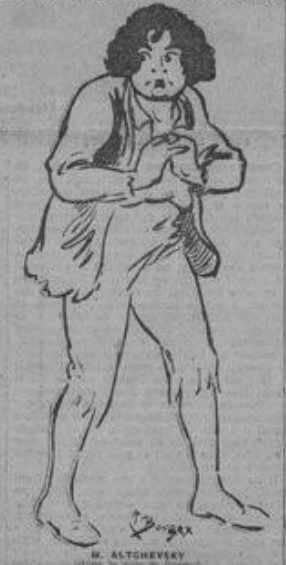
Scemo is a grim story of village superstition and mob violence in Corsica. The ‘Scemo’ (or Madman) of the title is the shepherd Lazaro, an ugly simpleton; the villagers believe he has the evil eye (a jettatore), and throw rocks at him. However, Francesca, the daughter of the local patriarch, falls in love with him – or with his eyes, which she likens to stars. “Tu n’es pas laid, puisque tes yeux sont beaux,” she tells him. The pair decide to elope, but are caught by her husband, Giovann’Anto, and her father, Arrigo di Leca. Arrigo orders Lazaro to leave the village; otherwise, he will starve to death: nobody will sell him meat or salt or bread. Lazaro angrily threatens him.
That night, Arrigo is overcome with terror, and dies, believing himself the victim of Lazaro’s sorcery. The villagers capture Lazaro, and prepare to burn him alive; however, to stop Francesca from lighting the pyre, and to prove his innocence, Lazaro blinds himself. Francesca declares her love for Lazaro, and the people believe her possessed.
The last act takes place at Easter: Lazaro – increasingly saintly, like the Œdipus of Colonus, renounces his love, and persuades Francesca to go back to her husband, leaving him alone and abandoned.
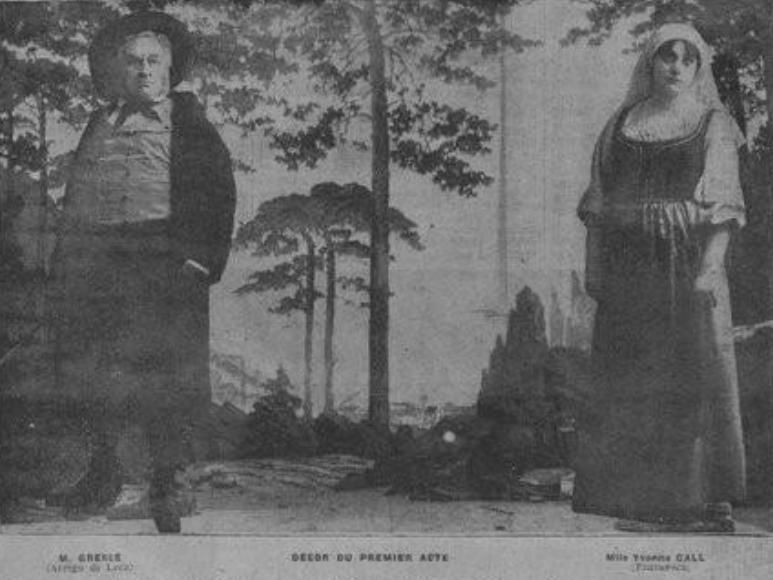
Bachelet was associated with Debussy and Dukas, and his score resembles their Impressionist approach: it is through-composed and highly chromatic, to the point that critics complained it was in no fixed key. It is tuneless and rather dreary, but conveys the situations effectively. Most of the choral passages – the crowd scenes in Act II and the return of the bells in Act III – are cut from the RTF recording.
Critics were strongly divided on the merits of Scemo. Pierre Lalo (Le Temps) considered it one of the best and strongest works that French art had produced in recent years, but acknowledged that it was not written for the admirers of Puccini. “Scemo‘s scenes have a variety of colours, along with an intensity of expression that is found only to a few degrees in very few works of this time.” He was struck by the fervent poetry of the love scenes of the first act; the sensation of mysterious anguish felt in the episode of Arrigo’s agony; the tragic scene of Lazaro’s punishment, with its expressive and beautiful choruses; the naturalness of the Easter dance and song; and the beauties of the final tableau, both in how it uses the liturgical theme of the Easter service and in its deep sensitivity and emotion.
Similarly, Émile Vuillermez (Comœdia) deemed Scemo “a significant work that commands esteem and respect… The quality of this spectacle, the loftiness of its lyrical conception, and its shining artistic integrity, enemy of any blameworthy concession, deeply honour our Académie Nationale de Musique.”
On the other hand, Isidore de Lara (composer of the once enormously popular Messaline) said contained Scemo contained some beautiful passages, but others that were laborious or ugly; Bachelet’s aesthetic was a deplorable example for young composers: “The terror of tonality, among modern artists, becomes a sickness, and among musicians, it distorts hearing… M. Bachelet seems to have the indifference towards vocal writing that we find in most of his fellow polyphonists. He makes a tenor scream prose on the high notes of his voice, and, through this process, the dramatic effect he seeks eludes him because the continuous strain on the part of the singers creates in the listener a feeling of weariness and irritation.”
The conservative Arthur Pougin (Le Ménestrel) condemned Bachelet and composers of his stamp as “the most ardent enemies of music, and who would inevitably lead it to its demise if allowed to proceed without protesting against their criminal tendencies”. He found the story lacking, the passion fake, and the scenes interminable. He detested the music: it lacked rhythm and tonality; the harmonies were harsh and incessant, and the vocal intervals extraordinary, causing discomfort for both singers and listeners; the music was sombre, monotonous, and overly complex; and the string instruments barely featured. “In all this, in this dense, laboured, and elaborate music, not a shadow, not only of a properly musical idea, but of feeling and expression; no room for grace, for tenderness, simply for sensitivity, everywhere an implacable heaviness and coldness, with glaring impersonality and an absolute lack of charm.”
Two decades later, Bachelet returned to the Opéra with Un Jardin sur l’Oronte (1932), set in the Middle East during the Crusades. Dukas called it one of the most magisterial operas to have appeared for a long time, but it was only performed 12 times. Nevertheless, the orchestral passages recorded are lovely.
Recordings
Listen to: Jean Mollien (Lazaro), Micheline Grancher (Francesca), Bernard Demingny (Giovann), Jacques Mars (Arrigo), and Lucien Lovano (Tomaso), with the Orchestre de la RTF, conducted by Tony Aubin, 1964.
Works consulted
- Émile Vuillermez, Comœdia, 5 May 1914
- Isidore de Lara, Gil Blas, 7 May 1914
- Arthur Pougin, Le Ménestrel, 9 May 1914
- Pierre Lalo, Le Temps, 29 May 1914
 The Opera Scribe