
Юдифь
- Opera in 5 acts
- Composer: Alexander Nikolayevich Serov
- Libretto: The composer, Apollon Maïkov, Dmitri Lobanov and Konstantine Zvantsev, after Paolo Giacometti
- First performed: Mariinsky Theatre, St. Petersburg, Russia, 28 May 1863
Characters
| JUDITH, an Israelite woman, widow of a Jewish warrior | Soprano | Valentina Bianchi |
| AVRA, her slave | Mezzo | A. A. Latycheva |
| OZIAS, an elder of the city of Bethulia | Bass | Ossip Pietrov |
| CHARMIS, an elder of the city of Bethulia | Bass | P. I. Goumbine |
| ELIACHIM, Jewish high priest | Bass | Vladimir Vassiliev |
| ACHIOR, chief of the Ammonites, subjugated to Holofernes | Tenor | Iossif Sietov |
| HOLOFERNES, Assyrian commander | Bass | Mikhaïl Sariotti |
| ASFANESES, retainer of Holofernes | Bass | I. Ratkovski |
| BAGOAS, head of Holofernes’s harem | Tenor | Pavel Boulakhov |
| Odalisques | Soprano Mezzo | |
| People, Jewish warriors, odalisques, Assyrian chiefs and warriors, feasters, male and female slaves of Holofernes |
SETTING: In and around Bethulia, Israel, the 6th century BCE.
For a time, Alexander Serov (1820–71) was the most popular opera composer in Russia. A civil servant and self-taught musician, he was a noted critic – he wrote some of the earliest appreciations in Russia of Mozart, Beethoven, Donizetti, Rossini, Meyerbeer, and Spontini – and an admirer (a self-styled ‘apostle’) of Wagner. He composed three operas: Judith, Rogneda (1865), both enormous successes, and The Power of the Fiend (1871). Tchaikovsky admired the first, but deemed the two others “mediocre, if not downright feeble”1.

Richard Taruskin2 considers Judith the first Russian music drama that consciously sought to do what Glinka did instinctively, while Martin Cooper3 suggests that Serov’s “importance in Russian musical history was perhaps that of a lesser Russian Meyerbeer”: his grand operas bridged the bel canto era of Glinka and more innovative composers like Tchaikovsky, Mussorgsky, and Rimsky-Korsakov. “Serov’s thorough professionalism was a new and wholesome element in Russian music, although it was not wedded to great creative powers”. On the other hand, Rosa Newmarch4 contends that Serov left no lasting traces on Russian opera.
Despite his historical importance, most consider Serov a crude musician, but acknowledge his dramatic sense. Tchaikovsky5 placed Judith (and Glinka’s Life for the Tsar) immediately below Mozart’s Don Giovanni; nevertheless, Serov, in his view, was gifted but not a first-rate talent; he lacked creative originality, but his works as a critic gave him a “huge stock of musical knowledge”. The music critic Vladimir Stasov6, his erstwhile friend and adviser to the Mighty Handful, argued that Serov was chiefly concerned with external ‘effects’: “A fanatical admirer of Meyerbeer, he nevertheless succeeded in catching up all the superficial characteristics of Wagner, from whom he derived his taste for marches, processions, festivals, every sort of ‘pomp and circumstance’, every kind of external decoration. But the inner world, the spiritual world, he ignored and never entered; it interested him not at all. The individualities of his dramatis personae were completely overlooked. They are mere marionettes.” Newmarch7 considered that Serov’s “strongest quality was a certain robust dramatic sense which corrected his special tendency to secure effects in the cheapest way, and kept him just on the right side of that line which divides realism from offensive coarseness and bathos”. More recently, Professor Alexeï Kandinski8 defined his attributes as “a strong theatrical sense, a dramatic density of the action, the abundance of contrasts, a sense for décor and spectacular effects, and, at the same time, a rudimentary and lapidary musical style aimed at pleasing the widest audiences”.
Judith is based on the Biblical story of the Jewish widow who delivers the town of Bethulia from the Assyrian general Holofernes – by hacking off his head when he has succumbed to drink. It began as an Italian libretto, then, when the prima donna turned up her nose, was reworked as a Russian one, several poets writing words to fit Serov’s music.
It is a five-act opera, divided into numbers, but much of the music is unstructured and declamatory. Cooper9 claims the style is Meyerbeerian, and Newmarch10 argues it recalls the Wagner of Tannhäuser and Lohengrin – but Serov’s melodic gift is more limited than either’s, and his orchestral writing often heavy and laboured, turgid and bombastic. Serov intended it as music drama, but it is not a successful one; indeed, Judith resembles an oratorio as much as it does an opera. The opening and closing acts are dominated by the chorus; the story is simplistic; the characters are flat; and the emotional range restricted. Judith is the only character who has a solo scene, opera’s usual way of conveying interiority, but she is not a complex character: she may be afraid, but she knows her duty, and does it.
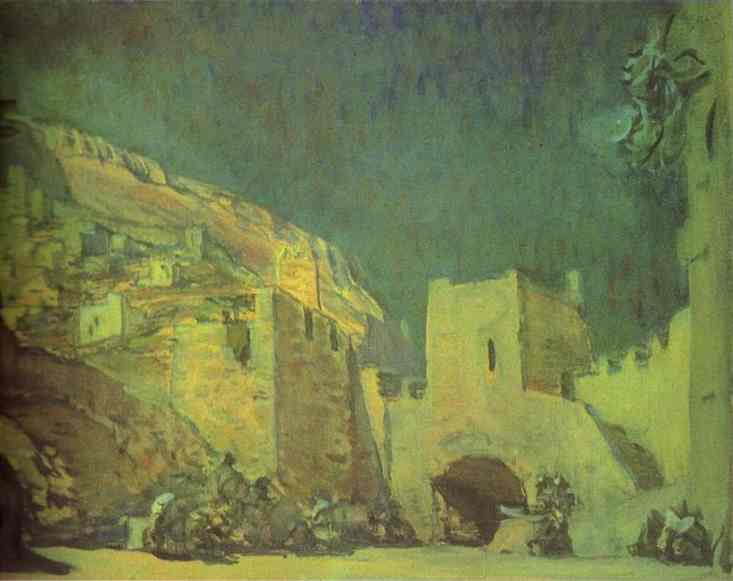
The prelude is stark and formless; it does not conclude, but leads into the scene. (On the whole, Serov seems to have had trouble linking sections; musical paragraphs sometimes sound like non sequiturs, or are linked by the simplest of chords.)
Act I takes place in a square in Bethulia, under the heat of the burning sun. Holofernes has captured the last water spring, and the people expect to die of thirst; the elders intend to deliver the village to the Assyrians within five days, but still pray for a miracle. Musically, the act is like groping through a wasteland at night. The colour is overwhelmingly BLACK: Serov is fond of tubas and the lower reaches of the strings, and the vocal parts are three basses (Russian basses at that), who declaim arioso, and a lamenting or praying chorus. There are occasional flashes of light, oddly like Parsifal in effect, when the priest invokes Jehovah.
Act II starts with Judith’s five-section monologue, largely declamatory, in which she reveals her intention to seduce and kill Holofernes. It is the opera’s one attempt at interiority; otherwise, as Stasov observed, the characters are puppets. Some of the vocal writing in the scene with the elders is good.
Acts III and IV take place in Holofernes’s Assyrian camp; the musical style is alternately militaristic or languorous, in contrast to the austerity of the Jewish acts. On the one hand, there is an imposing march (reminiscent of Chernomor’s March in Ruslan and Lyudmila); an aggressive chorus to end Act III; a very crude and noisy orgy in Act IV; Holofernes’s war song; and a drunken scene that, Cooper11 suggests, influenced Boris Godunov’s nightmares. On the other hand, there are choruses and dances almahs, odalisques and asterisks (an influence on Borodin’s Polovtsian Dances?); and a Hindu song (potential there, as Rimsky-Korsakov recognised in Sadko). Also, Act IV begins with a brooding Wagnerian prelude.
The best music in the opera comes at the very end: the final ensemble contains a lovely soaring melody sung by Judith as she praises Jehovah.
Judith was as great a success as A Life for the Tsar had been 30 years before, and made Serov famous overnight. “In this opera,” Tchaikovsky wrote, “there are masses of merit. It is written with extraordinary warmth and feeling, and in places it attains great heights of power.”12 Newmarch13 is more reserved in her praise: according to her, Judith is “picturesque and effective, although the musical colouring is somewhat coarse and flashy. Serov excels in strong scenic effects, but we miss the careful attention to detail, and the delicate musical treatment, characteristic of Glinka’s work.”
Judith has never been performed in the West.
Recordings
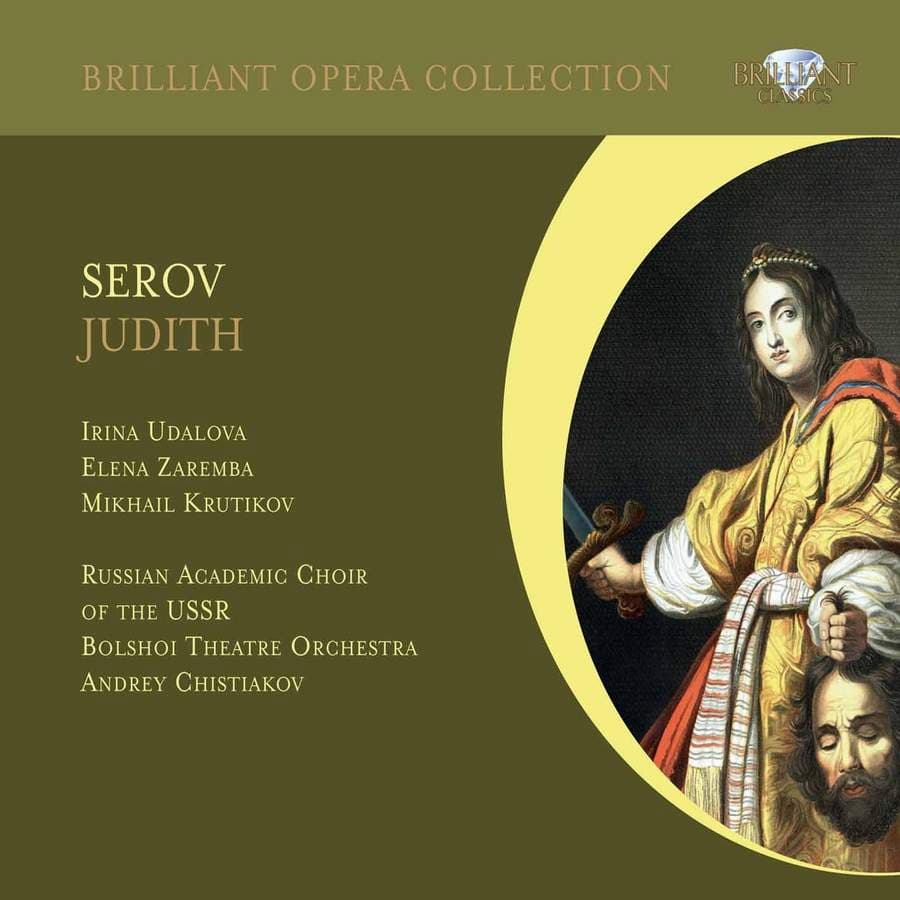
Listen to: Irina Udalova (Judith), Elena Zaremba (Avra), and Mikhail Krutikov (Holofernes), with the Russian Academic Choir of the USSR and Bolshoi Theatre Orchestra, conducted by Andrey Chistyakov, 1991; Brilliant Classics.
Works consulted
- Rosa Newmarch, The Russian Opera, London: Herbert Jackson, 1914.
- Martin Cooper, Russian Opera, London: M. Parrish, 1951.
- Richard Taruskin, Opera and Drama in Russia As Preached and Practiced in the 1860s, University of Rochester Press, 1981.
- Professor Alexeï Kandinski, essay accompanying 1991 recording.
- Piotr Kaminski, Mille et un opéras, Paris : Fayard, 2003.
- Aleksandr Serov – Tchaikovsky Research (tchaikovsky-research.net).
See also Phil’s Opera World.
- Aleksandr Serov – Tchaikovsky Research (tchaikovsky-research.net). ↩︎
- Richard Taruskin, Opera and Drama in Russia As Preached and Practiced in the 1860s, University of Rochester Press, 1981. ↩︎
- Martin Cooper, Russian Opera, London: M. Parrish, 1951, p. 37. ↩︎
- Rosa Newmarch, The Russian Opera, London: Herbert Jackson, 1914, p. 160. ↩︎
- Tchaikovsky Research, op. cit. ↩︎
- Quoted in Newmarch, p. 160. ↩︎
- Newmarch, p. 160. ↩︎
- Professor Alexeï Kandinski, essay accompanying 1991 recording, p. 12. ↩︎
- Cooper, p. 28. ↩︎
- Newmarch, p. 152. ↩︎
- Cooper, pp. 28-29. ↩︎
- Tchaikovsky Research, op. cit. ↩︎
- Newmarch, p. 152. ↩︎
 The Opera Scribe