

DER HOCHMÜTIGE, GESTÜRZTE UND WIEDER ERHABENE CROESUS
- Composer: Reinhard Keiser
- Libretto: Lukas von Bostel, after Nicolò Minato’s 1678 opera
- First performed: Theater am Gänsemarkt, Hamburg, 1711.
- Revised: Theater am Gänsemarkt, Hamburg, 6 December 1730
| CROESUS, King of Lydia | Tenor | |
| ATIS, his son | Sopranist | |
| HALIMACUS, Atis’s confidant | Countertenor | |
| ORSANES, a member of Croesus’s court | Baritone | |
| ELIATES, a member of Croesus’s court | Tenor | |
| CLERIDA, a member of Croesus’s court | Soprano | |
| ELMIRA, daughter of the exiled queen of the Medes | Soprano | |
| CYRUS THE GREAT, King of Persia | Bass | |
| SOLON, a philosopher | Baritone | |
| ELCIUS, a servant in Croesus’s court | Tenor | |
| TRIGESTA, Elmira’s attendant | Soprano | |
| A Persian captain | Baritone |
SETTING: Lydia, 6th century B.C.
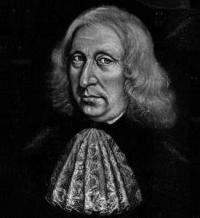
Reinhard Keiser was once hailed as “the greatest opera composer in the world” (Johann Mattheson, writing his obituary in 1740). Thirty years later, one Scheibe called him “the greatest original genius in music that Germany has ever produced”. (I can hear the eyebrows of several hundred Bach enthusiasts shoot into orbit.) Handel and Hasse merely borrowed and reworked his ideas.
He was the most frequently performed composer in Hamburg for 20 years at the turn of the 18th century; he is almost completely unknown today. By the end of the century, he had fallen into obscurity – and into obloquy by the 19th, who dismissed him as immoral and a follower. Two-thirds of his 60 operas are lost.
René Jacobs recorded Croesus in 2000, attracted by the work’s carnivalesque mockery of the heroic, the moral, the courtly, and the exalted. This was the 1730 version; Keiser first set the work in 1710/11, but the score has vanished into history. For the revision, Keiser completely rewrote 37 of the 51 numbers, and altered some of the vocal parts.
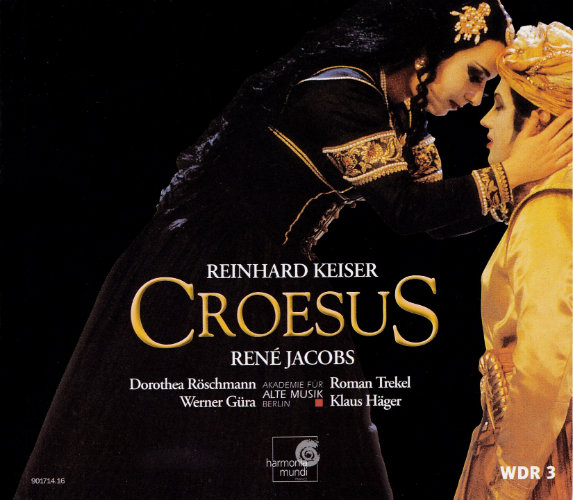
The score never stays still. Numbers rush by, many lasting no more than a minute. There are choruses, arias, duets, quartets, ballets of clowns and Persian soldiers, and some fairly ghastly children.
The generosity of the score almost bewilders some modern listeners. Piotr Kaminski compares it to an irresistible whirlwind and to a kaleidoscope, and Walter Rösler to a treasure trove. Tim Albery (Guardian, October 11, 2007) was “taken aback by its exuberant lyricism… There was a sense of profusion, of an incredibly generous, almost out-of-control fertility, of a Romantic spirit not to be hemmed in by classical restraint.”
The story is almost Shakespearean in its prodigality. In its three hours, Croesus combines a serious historical plot, with kings captured or tyrannical, battlefields strewn with corpses, dungeon cells, sentences of death, and a Greek philosopher to provide a moral; a complicated romantic comedy, with a hero first dumb then in disguise, a scheming traitor, and a beautiful but haughty princess; and a jester who mocks both plots.
The libretto was based on Niccolò Minato’s 1678 opera Creso (music by the Holy Roman Emperor Leopold I). We’ve already come across Minato’s plays; he wrote the text for Handel’s Serse. Both are tragicomedies, which never treat either royalty or the extravagant plot entirely seriously.
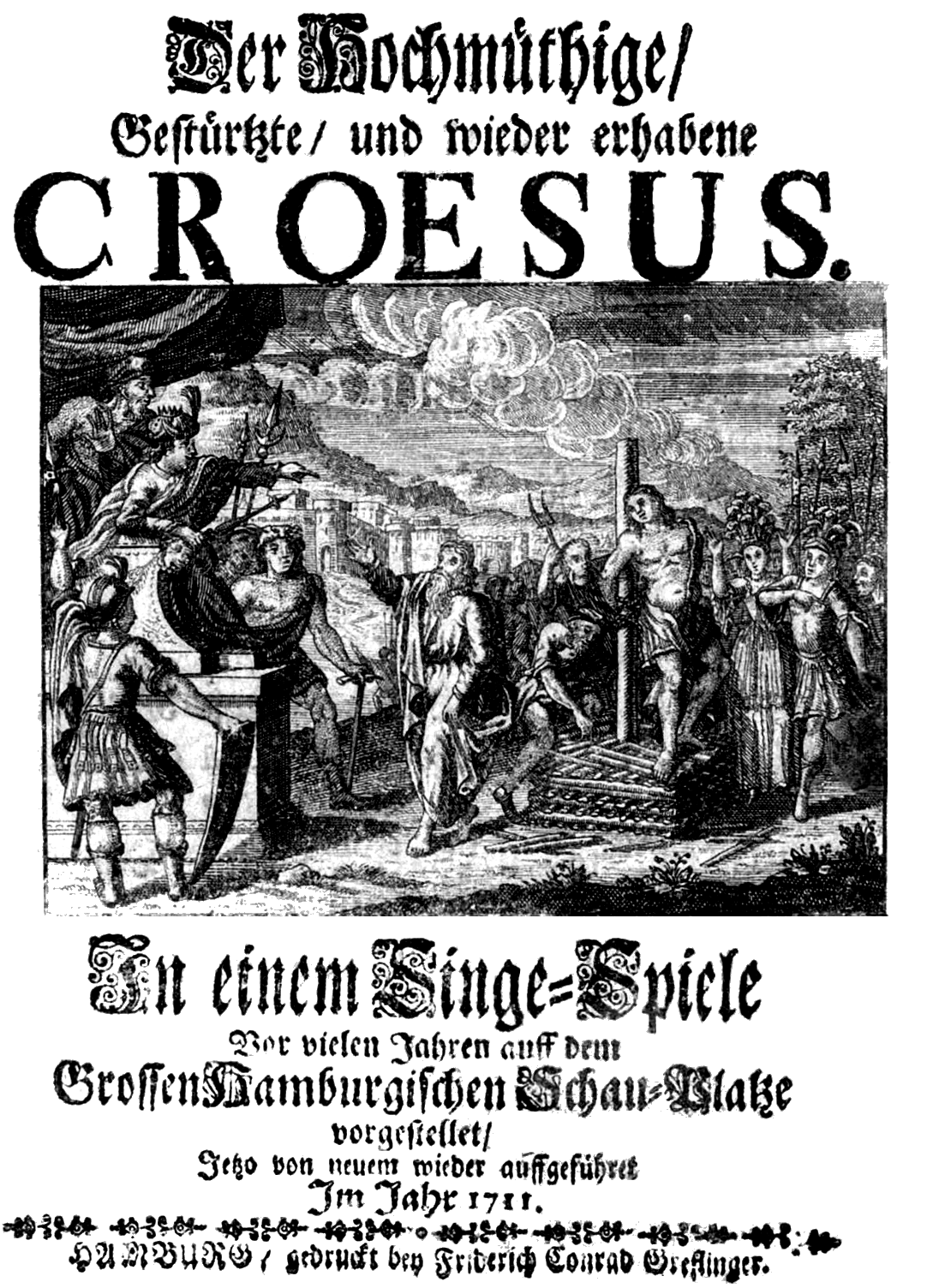
The fabulously wealthy Croesus, king of Lydia, nearly loses throne, life, and fortune when the Persian king Cyrus invades, and sentences his enemy to be burnt alive. Croesus mounts the funeral pyre, and remembers the wise Solon’s scorn for his treasures. Call no man happy until he is dead (a favorite maxim of the Greeks), because the wheel of fortune can turn. Cyrus, too, realizes that his prosperity could end, and he fall. He releases Croesus, who swears loyalty to the shah. The moral, Bostel writes, is “the inconstancy of worldly glory and riches”.
Croesus’s son Atis is dumb – not intellectually, but linguistically. He cannot speak, but that is no obstacle to his romance with the Median princess Elmira. They communicate through gestures. Atis suddenly gains his speech when he cries out to save his father’s life. To preserve his own, he disguises himself as a peasant. In this guise, he presents himself to Elmira as a gift from Atis, to test her faithfulness. The villainous prince Orsanes loves Elmira, and covets the throne. He plots to have the pseudo-peasant smother the prince, then place the impostor on the throne as a puppet. There are two minor noble characters in this plot: Eliates loves Clerida loves Orsanes.
The clown-servant Elcius comments on the action and concerns of the aristocracy, like Falstaff or (at his most rancid) like Thersites. Love, to him, is the capers of “Venus’s little whoreson, the bear-skinner, the arch-scoundrel”; better for him a beaker of good wine. Elmira declares her love for Atis; to the same tune, Elcius declares his longing for roast meat and Rhine wine. Before the battle, he dons clownish armour, mocked by four harlequins – but, he claims, a manly heart will fight and conquer with laughter and jest. Later, he turns up as a campfollower, selling glasses, flax-combs, mousetraps, and sulphur (for syphilis?).
The overture (con brio) is thrillingly joyful; it’s one of the best overtures of its time that I know, alongside Vinci’s Catone and Artaserse. Act I opens with a terrific allegro opening chorus, “Croesus herrsche, Croesus lebe”.
The highlight of the act (and arguably the opera) is a virtuoso run of ensembles: a duet “Du mußt scheiden” (Elmira, Nerillus); another duet, “Ich sä’ auf wilde Wellen”, less than a minute; a third duet, “Blindes Feu’r, das mich verzebret”, which turns into a quartetto, “Clerida, du hältst gefangen”; and ends in an aria for Elmira, “Traure nicht”.
As prima donna, Elmira has most of the da capo arias. Her Act II aria alla siciliana, “Liebe, sag, was fängst du an?” hovers between fear and hope, with a lovely, slow A section, and a B section of almost orgasmic coloratura. Other fine numbers include her “Er erweckt in meinem Herzen“, which sounds almost like Mozart fifty years early; the tiny, delicate “Sobald dich nur mein Auge sah”; and the warm, tender “Mir gefällt in seinem Munde”.
Why, then, only four stars? There is much to admire in Croesus, but not having seen it “live”, that admiration hasn’t deepened into the love I feel for, say, Artaserse or Serse. The adventurous opera lover, though, should definitely seek out the buried treasures of Croesus.

WORKS CONSULTED
- René Jacobs. Why produce Croesus today? (in Harmonia Mundi CD)
- Piotr Kaminski, Mille et un opéras, Paris : Fayard, 2003
- Walter Rösler. Reinhard Keiser “ Le premier homme du monde » (Harmonia Mundi CD)
RECORDING
Dorothea Röschmann (Elmira), Roman Trekel (Croesus), Werner Güra (Atis), and Klaus Häger (Orsanes), with René Jacobs conducting the Akademie für Alte Musik Berlin, 2000. Harmonia Mundi.


Interesting. I’ve had this in my collection for some time now, maybe now would be a good time to listen to it!
A suggestion: please try getting around to Handel’s second great trilogy: Orlando, Ariodante and Alcina. Maybe they’ll have better luck for you than Giulio Cesare!
LikeLiked by 1 person
That’s a good suggestion; I’d planned to hear a couple more Handels before moving forward. Any recommendations for recordings?
LikeLike
There are first rate Orlandos from Christie and Hogwood that I own. Either will serve.
Have a gander at this, which is still a bargain (though I got it much cheaper when it came out!)
https://www.amazon.com/Opera-Baroque-Various-Artists/dp/B00DHCJLWG/ref=sr_1_1?keywords=Baroque+opera+Harmonia+Mundi&qid=1557931027&s=gateway&sr=8-1
LikeLike
Yes, I have the Christie Orlando also(I truly believe this is his best opera, IMO of course) And I’ve got two Alcinas: Christie and Curtis, both are outstanding. Ariodante, I have the ever reliable Minkowski with van Otter.
LikeLiked by 1 person
I’ve bought the Curtis Alcina and the Jacobs Orlando. I have the Minkowski Ariodante at home.
LikeLike
B’ Rock orchestra… cute. I must investigate the Jacobs which you’ve brought to my attention, thanks!
LikeLike
Listened to the Jacobs recording of Orlando. It’s well sung (particularly Bejun Mehta), but the story’s boring, and there are far too many slow arias in the minor. Better than Lully, but nowhere close to Vivaldi.
LikeLike
That’s a shame. I have a feeling Handel’s a lost cause for you, no worries, don’t listen to things you don’t like is my motto.
I have some more Vivaldi recommendations for you if you want.
LikeLike
Glad you liked it! It’s an incredible grab bag of invention and melody.
Much like that greatest of Baroque operas, Giulio Cesare… 😉
LikeLiked by 1 person