
- Opéra-comique in 5 acts
- Composer: Henri Rabaud
- Libretto: Lucien Népoty, based on the 1001 Nights (translated by Dr. J. C. Mardrus)
- First performed: Théâtre National de l’Opéra-Comique, Paris, 15 May 1914, conducted by François Rühlmann
| MÂROUF | Baritone / tenor | Jean Périer |
| FATTOUMAH the Calamitous, Mârouf’s wife | Soprano | Jeanne Tiphaine |
| The SULTAN of Khaïtân | Bass | Félix Vieuille |
| Princess SAAMCHEDDINE, the Sultan’s daughter | Soprano | Marthe Davelli |
| The VIZIER | Baritone | Jean Delvoye |
| ALI | Baritone | Daniel Vigneau |
| The Fellah | Ténor | Eugène de Creus |
| The pastry cook Ahmad | Bass | Louis Azéma |
| First Merchant | Ténor | Maurice Cazeneuve |
| Second Merchant | Bass | Éric Audouin |
| The Qadi | Bass | Paul Payan |
| A Donkey Driver | Ténor | Donval |
| Chief Sailor, and a Muezzin | Tenor | Eugène de Creus |
| A Muezzin | Tenor | Thibaud |
| Mamelouks | Basses | Jean Reymond Brun |
| Policemen | Basses or tenors | Pierre Deloger Corbières |
SETTING: Cairo, Khaïtân, and in the desert, in legendary times.
Opéra-Comique audiences of the late 18th and early 19th centuries had long delighted in Arabian Nights fantasies, with sultans and viziers, beautiful princesses, deserts and djinns, caravans and minarets. [FN 1] Rabaud revivified the genre for an audience that had heard the Impressionists and the Russians. The result was one of the Opéra-Comique’s greatest successes of the twentieth century.
[1] See, for instance, Grétry’s Caravane du Caire (1783) and Boieldieu’s Calife de Bagdad (1800), or Herold’s Clochette (1817), Niccolo Isouard’s Aladin (1822), or Cherubini’s Ali Baba (1833). Later in the century, Reyer’s Statue (1861), and a couple of symphonic pieces: David’s Désert (1844) and Reyer’s Sélam (1850).
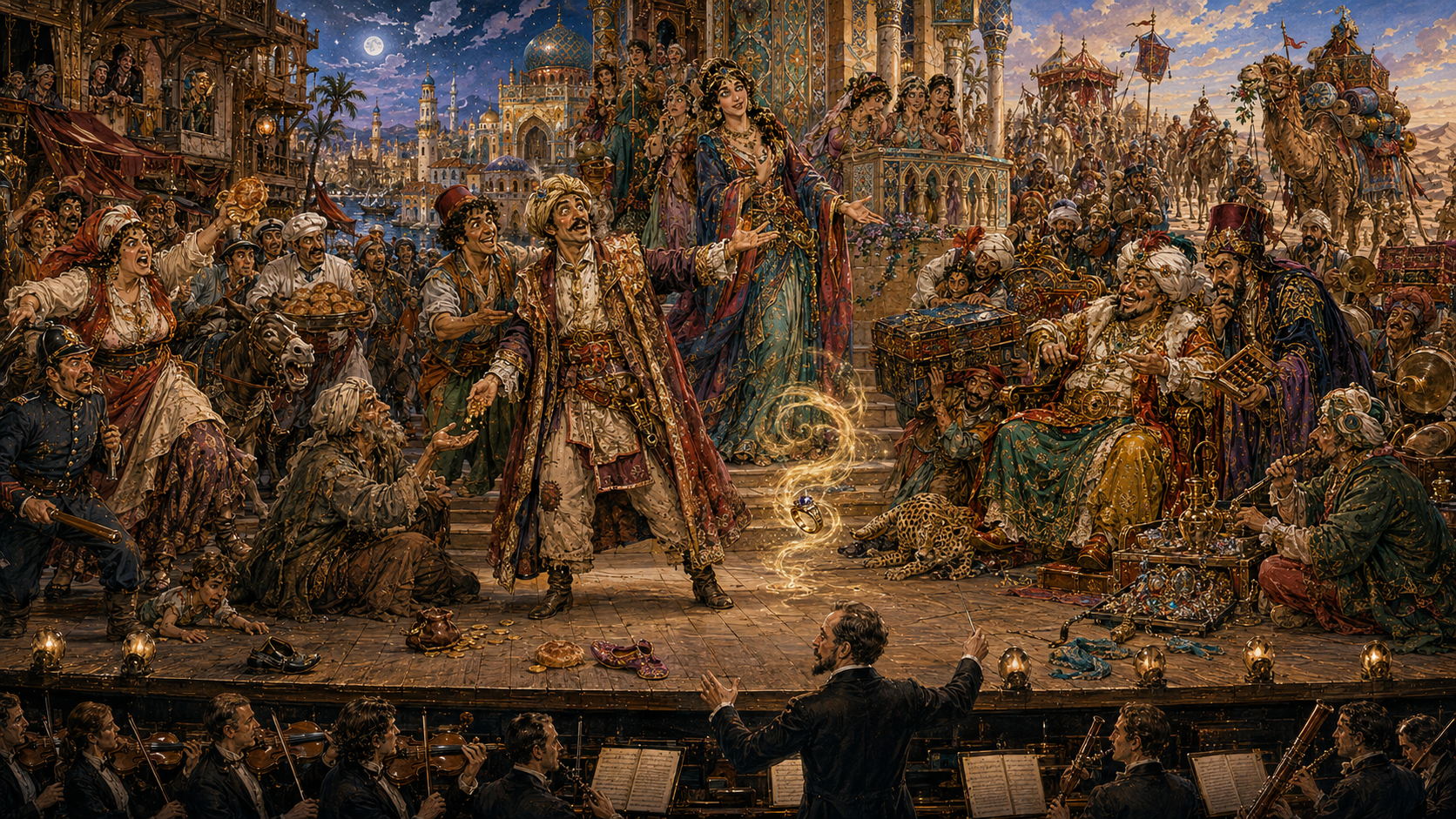
Mârouf is a humble cobbler and a henpecked husband, unhappily married to Fattoumah (“the Calamitous”). She falsely accuses him of assault, because he brought her the wrong type of knafeh (an Arab dessert), and he is beaten by the Qadi’s police. Tired of his blackhearted wife and his miserable lot, he runs away to sea. But in the interval between Acts I and II, Mârouf is shipwrecked. Fortunately, he is found by a wealthy merchant, Ali, who turns out to be his childhood friend, whom he has not seen for 20 years. Determined to do his friend a good turn, Ali tells everyone that Mârouf is the greatest merchant in the world. Mârouf gives a purse of 1,000 dinars to a beggar – who is (of course) really the sultan in disguise. More, Mârouf pretends that he is waiting on his caravan: 1,000 camels carrying fabrics and baskets of silver and jewels; 1,400 mules laden with diamonds, rubies, and sapphires; 1,000 mamluks; and another 100 camels bearing bags of gold. The sultan and his vizier, overhearing this, invite Mârouf to dinner. More, the sultan marries Mârouf to his daughter, the scrumptious Princess Saamcheddine. The cobbler and the princess fall madly in love, and Mârouf confesses that he is only a poor man. The couple run away from the palace, pursued by the Sultan’s guards. (The princess, naturally, is disguised as a boy.) Luckily, they find a magic ring that summons a djinn, guardian of the treasure of Scheddad, son of Aad; Mârouf at last has his treasure. The Sultan and vizier capture the runaway couple, and are about to execute Mârouf and Ali when the fabled caravan appears. Impressed by his son-in-law’s magnificent wealth, the Sultan begs Mârouf for forgiveness. All ends happily, with an ensemble praising Allah. (The opera might seem full of coincidences, but everything that happens is the will of Allah.)
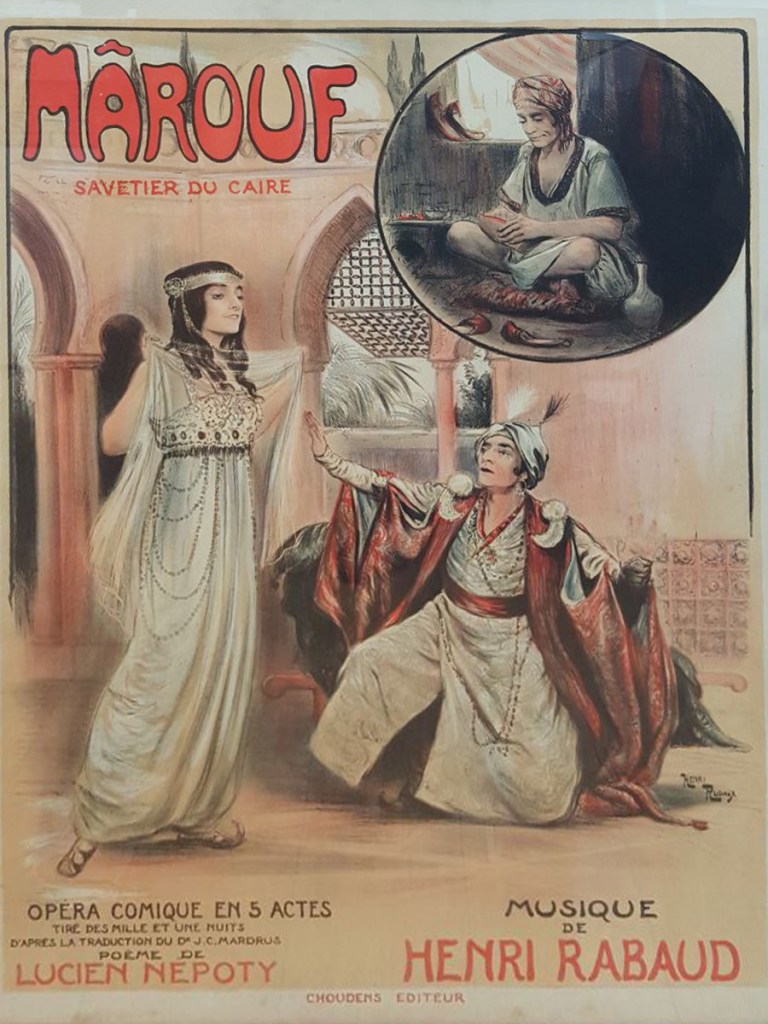
On the eve of World War I, Albert Carré, director of the Opéra-Comique, commissioned Henri Rabaud, conductor at the theatre, to write this light-hearted entertainment. For the last decade, the Opéra- Comique’s premières had apparently been anything but comic; Arthur Pougin (Le Ménestrel) complained that it was a nightmare of massacres, murders, poisonings, and suicides.
Rabaud had music in his blood. His father was a cello professor at the Paris Conservatoire; his mother was a singer; and his great-aunt was the coloratura soprano Julie Dorus-Gras (who created lead rôles in Meyerbeer’s Robert le Diable and Les Huguenots, Auber’s Gustave III, Halévy’s La Juive and Guido et Ginevra, and Berlioz’s Benvenuto Cellini). He studied with Massenet, and won the Prix de Rome in 1894, aged 20. A decade after Mârouf, he succeeded Gabrel Fauré as director of the Conservatoire. The qualities of his music, Pougin thought, were clarity, tonal and rhythmic feeling, melodic abundance, grace and gaiety, and a very sharp theatrical sense.
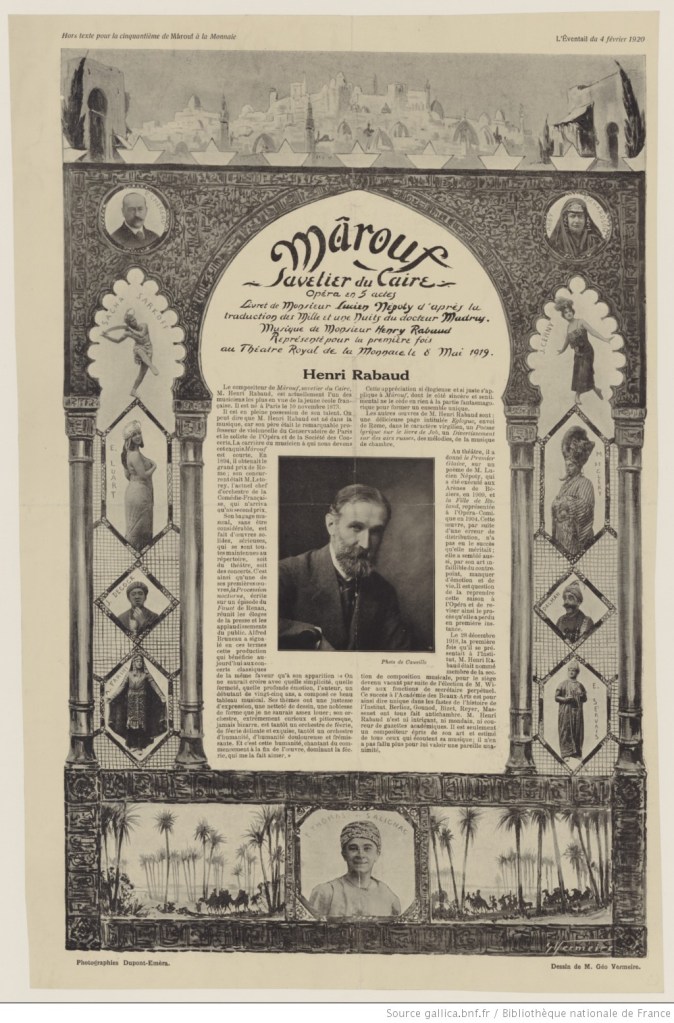
Mârouf is a ravishing mixture of Rimsky-Korsakovian Orientalism, post-Debussyian prosody, and Massenetian melody. There is a strong Middle Eastern flavour to the score (pentatonic and whole-tone scales galore; Arab rhythms and muezzin chants; ‘exotic’ wind and percussion instruments), while the libretto is peppered with Arabic ejaculations and invocations. But the score also shows the influence of the Russians; Sergei Diaghilev’s Ballets Russes had brought Eastern European music to France. In Act I, for instance, the wife’s shrill bullying seems inspired by Stravinsky’s Petrushka (1911), while the burnished chords at the start of Act III recall Rimsky-Korsakov, whose Scheherazade was performed in Paris in 1910.
The most famous piece in the score is Mârouf’s “À travers le desert”, which evokes the slow journey of the caravan bearing treasure. It has been performed by French tenors from Georges Thill to Roberto Alagna.
Act III, set in the sultan’s palace, is musically rich; the scene where Mârouf lavishly distributes gold (emptying the Sultan’s treasury to do so) is a lavish ballet. (More echoes of Rimsky.) It culminates in the appearance of the Princess on the balcony (a shimmering passage). Albert Dayrolles (Annales politiques et littéraires) called it “a delicious divertissement for the ear and the eye”.
Later, Mârouf’s ecstatic prayer (“Allah est le seul grand”) when he beholds the Princess’s unveiled face. The act ends with a delightful orchestral melody. Act IV is notable for the Princess’s two beautiful phrases, describing her husband’s charms to the vizier (“Ce que je pense de l’époux”) and her declaration of love (“Mârouf, il n’est pas de richesse que je te préfère”). In Act V, the Princess’s allegretto ballad (“Ils s’enfuirent tous les deux”) is startlingly old-school Opéra-Comique.
Audiences adored Mârouf; so did the critics. “The score of Mârouf,” Gabriel Fauré wrote, “absolutely deserves the great success it obtained, a success which I believe is long-lasting and which it owes to its essentially musical qualities, to the abundance, variety, and charm of the ideas, to the solidity of the style, to the charm of the colour, to some very witty musical periods, finally to its healthy good humour from start to finish.” Pougin declared that the score was “lively, alert, varied, essentially musical, saying what it had to say well and with charm, full of clear and well-expressed ideas… It was written with skill, and above all had that precious and rare quality: style.”
Mârouf was performed 128 times at the Paris Opéra-Comique by 1950, and 124 times at the Opéra by 1950. It was performed around the world, from Milan (La Scala) and New York (the Met) to Stockholm and Buenos Aires. It was performed at the Opéra-Comique in 2013 and 2018; Bachtrack called it “a minor treasure”. Certainly, this score is as full of jewels as Mârouf’s caravan.
Recordings
Listen to: Jean-Sébastien Bou (Mârouf), Nathalie Manfrino (Princesse Saamcheddine), Nicolas Courjal (the Sultan), and Frank Leguérinel (the Vizier), with the Chœur Accentus and the Orchestre Philharmonique de Radio-France, conducted by Alain Altinoglu, Paris, 2013. (The
Works consulted
- Gabriel Fauré, Figaro, 15 May 1914
- Arthur Pougin, Le Ménestrel, 23 May 1914
- Albert Dayrolles, Les Annales politiques et littéraires, 24 May 1914
- Piotr Kaminski, Mille et un opéras, Paris : Fayard, 2003
- Vincent Giroud, French Opera: A Short History, Yale University Press, 2010


One thought on “249. Mârouf, savetier du Caire (Rabaud)”