
- Composer: Ferruccio Busoni
- First performed: Stadtheater, Zurich, 11th May 1917, conducted by the composer
“It is within the realm of opera to seize the supernatural or the unnatural, and in so doing, create a world of illusion that reflects life either in a magic mirror or in a laughter mirror; its conscious intent should be to represent that which is not to be found in real life. The magic mirror for serious opera, the laughter mirror for comic opera. And it should be interwoven with dancing and masked balls and ghosts, so that audiences see the seductive lie at every twist and turn, and do not abandon themselves to it as they might a real experience.”
So argued Ferruccio Busoni, and it was the maxim he adopted in his own operas: two commedie dell’arte, one set in mythical China, and a treatment of the Faust legend.
Busoni (1866–1924) – child prodigy and gifted pianist – advocated for Young Classicism: “the mastery, examination, and exploitation of all the gains of previous musical experiments and their inclusion in solid and beautiful forms, a definite departure from the thematic and a return to melody, and the removal of the ‘sensual’ and renunciation of subjectivity”.
His music is eclectic and cosmopolitan: he adored Mozart and Rossini, was one of the world’s leading performers of Bach and Liszt, and insisted that music must turn away from Wagner – but he was also a friend of Schoenberg, and the teacher of Kurt Weill and Percy Grainger. His music is on the one hand clear and tuneful, but employs novel harmonies and orchestral textures, and frequent shifts in tonal centre. It is music that is ‘modern’, but which traditional music lovers can easily enjoy.
Arlecchino, oder die Fenster
- Theatrical capriccio in 1 act
- Libretto: Busoni
Characters
| SER MATTEO DEL SARTO, tailor-master | Baritone | Wilhelm Bockholt |
| ABBATE COSPICUO | Baritone | Augustus Milner |
| DOTTOR BOMBASTO | Bass | Henrich Kuhn |
| ARLECCHINO | Speaking rôle | Alexander Moissi |
| LEANDRO, cavalier | Tenor | Eduard Grunert |
| ANNUNZIATA, Matteo’s wife | Silent | Ilse Ewaldt |
| COLOMBINA / PULCINELLA, Arlecchino’s wife | Mezzo | Käthe Wenck |
| Two Constables A Carter People at the windows A donkey | Silent |
Setting: Bergamo, in the 18th century
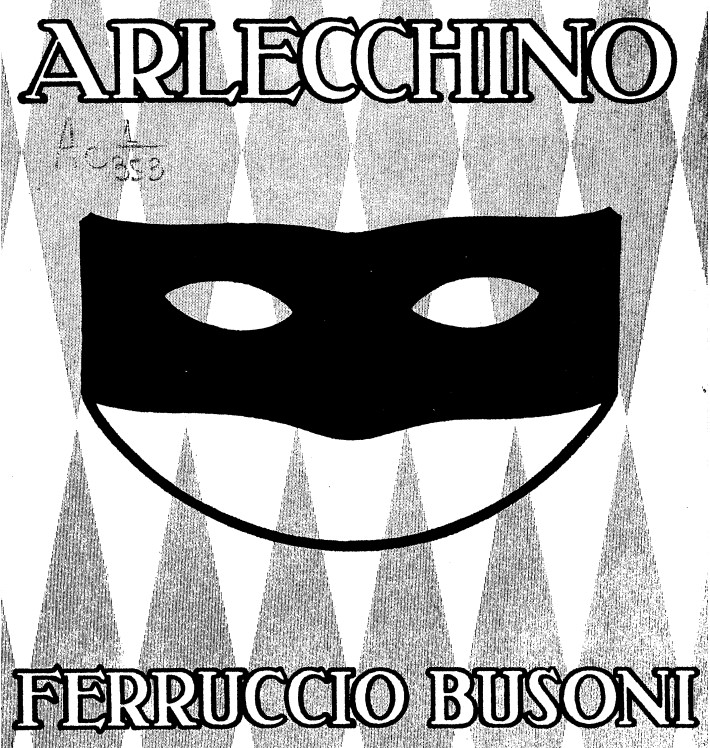
In 1917, Busoni expressed his frustration with World War I with this lively commedia dell’arte. It was, he wrote, his “joyful confession” (“mia confessione giocosa”) – and Edward J. Dent notes that it was his most individual and personal work. Through the trickster figure of Arlecchino (Harlequin), he ridiculed militarism, nationalism, marriage, human stupidity, and opera itself.
The work is divided into four sections, depicting Arlecchino as Rogue (seducing a tailor’s wife), as Warrior (enlisting the tailor in the army), as Husband (running away from Colombina, who enjoys the attentions of a fatuous knight), and ultimately Victorious. Arlecchino alone does not sing; a creature of words and action, he does not fall under music’s intoxicating influence. Busoni pokes fun at both religion (an alcoholic, womanising priest) and science (a pompous doctor), and at indifference to suffering (the townsfolk close their windows and ignore appeals to help a wounded man). Busoni wrote that the opera “has a tendency to ambiguity and hyperbole in order to place the listener momentarily in a position of slight doubt; it adheres constantly to a constant play of colour between grim jest and playful seriousness”. Dent suggests that is why the work never became popular, “for it leaves an audience bewildered and somewhat uncomfortable”. A 21st-century audience, however, will find little to shock their sensibilities, but much to amuse.
The opera also pays homage to, and pokes affectionate fun, at opera itself. Busoni said Arlecchino “was meant to ‘scourge’ post-Wagnerian opera a little; it is an opera that itself turns against opera”. The idiom is post-Falstaffian – lots of fleeting little melodies that last only a few bars, before Busoni moves onto the next idea – although there are a couple of notable extended numbers: a parody of the old-fashioned bel canto tenor / soprano duet (finishing in a stretta) and a quartet praising the donkey (the emblem of Busoni’s hometown). There are knowing quotations from Mozart (Don Giovanni’s Champagne Aria), Beethoven, and Gluck; and a march attributed to Donizetti. The occasional brittleness of the music, jaunty rhythms, and self-awareness of the text look forward to Prokofiev’s Love for Three Oranges, another commedia dell’arte inspired work.
Recordings
Listen to: Peter Matič (Arlecchino); René Pape (Ser Matteo del Sarto); Siegfried Lorenz (Abbate Cospicuo); Peter Lika (Dottor Bombasto); Robert Wörle (Leandro); Marcia Bellamy (Colombina, sung), with the Berlin Radio Symphony Orchestra, conducted by Gerd Albrecht, Berlin, 1994.
Watch: Marco Alemanno (Arlecchino); Maurizio Lo Piccolo (Ser Matteo del Sarto); Massimiliano Gagliardo (L’Abbate Cospicuo); Ugo Guagliardo (Il dottor Bombasto); Lucio Dalla (Pulcinella); Filippo Adami (Leandro); with the Orchestra del Teatro Comunale di Bologna, conducted by David Agler, directed by Lucio Dalla, Bologna, 2007
Turandot
- Chinese fable after Gozzi in 2 acts
- Libretto: Busoni, after Carlo Gozzi’s play (1762)
Characters
| ALTOUM, Emperor | Bass | Laurenz Saeger-Pieroth |
| TURANDOT, his daughter | Soprano | Inez Encke |
| ADELMA, her confidante | Mezzo | Marie Smeikal |
| KALAF | Tenor | August Richter |
| BARAK, his servant | Baritone | Tristan Rawson |
| QUEEN MOTHER OF SAMARKAND, a Moor | Soprano | Elisabeth Rabbow |
| TRUFFALDINO, chief eunuch | Tenor | Eugen Nusselt |
| PANTALONE, minister | Bass | Heinrich Kuhn |
| TARTAGLIA, minister | Bass | William Bockholt |
| Eight Doctors | Paul McGann | |
| A Singer | Mezzo | Marie Smeikal |
| The Executioner | Silent | Eduard Siding |
| Slaves; Dancers; Mourners; Eunuchs; Soldiers ; a Priest |
TIME: The Fable
LOCATION: The farthest East
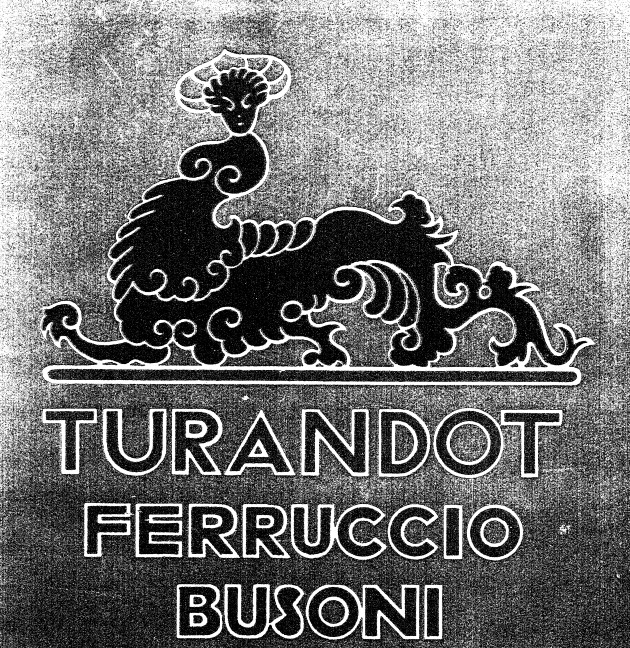
Turandot was written to accompany Arlecchino, which would not provide a full evening’s entertainment on its own. Busoni converted his Turandot Suite, incidental music he had written for a 1905 production of Gozzi’s play, into an opera. Beaumont considers the resulting work “little more than an ingenious arrangement and extension of the original incidental music”, and lightly dismisses it: “neither dramatically nor musically on a par with Arlecchino”, it is “overshadowed – justifiably – by Puccini’s opera”.
It is a slighter (and more wholesome) opera than Puccini’s, true; its ironic tone is closer to Gozzi’s original play. Turandot is less of a monster, and her thawing is better prepared for: in Act II (after the riddle scene), she admits she both loves and hates Calaf. The unknown prince is more sympathetic, and morally unblemished, too. There is no Liù figure; instead, the woman who knows his identity is Turandot’s confidante, Adelma, whom he spurned; she survives the opera. Three commedia dell’arte figures comment on the action, not letting us take it too seriously. “In Italy, Majesty, everyone is delighted when there’s murder and mayhem on stage,” says Pantalone. “But I understand that it’s of a gruesome taste.” For all its fairy tale nature, the characters are closer to flesh and blood than Puccini’s, and the happy ending more convincing.
While it is “overshadowed” by Puccini’s (two-thirds of a) masterpiece, it contains many gorgeous things. Busoni employs Wagnerian declamation; ‘exotic’ orchestral colour; and authentic Chinese, Arab, Byzantine, Indian, and Nubian melodies. There are striking moments of invention (such as the weird chromatic keening of the Queen of Samarkand and her women); noble Mozartean bass arias (Altoum is essentially Sarastro); buffo patter songs; and some grand ensembles (the scene when Turandot beholds Calaf for the first time, for instance; the Act I finale when Calaf challenges her to find his name; or the Act II finale). It is a heady combination, and one of the most enjoyable operas I have heard for a long time.
Recordings
Listen to: René Pape (Altoum); Linda Plech (Turandot); Gabriele Schreckenbach (Adelma); Josef Protschka (Kalaf); Friedrich Molsberger (Barak); Celina Lindsley (Queen Mother); Robert Wörle (Truffaldino); Johannes Werner Prein (Pantalone); Gotthold Schwarz (Tartaglia), with the Berlin Radio Symphony Orchestra, conducted by Gerd Albrecht, Berlin, 1993.
(I cannot recommend the Wexford video recording, on YouTube; the sound is poor.)
Works consulted
- Antony Beaumont, Busoni the Composer, Bloomington: Indiana University Press, 1985
- Edward J. Dent, Ferruccio Busoni: A Biography, London: Eulenburg Books, 1974
- Piotr Kaminski, Mille et un opéras, Paris : Fayard, 2003
 The Opera Scribe