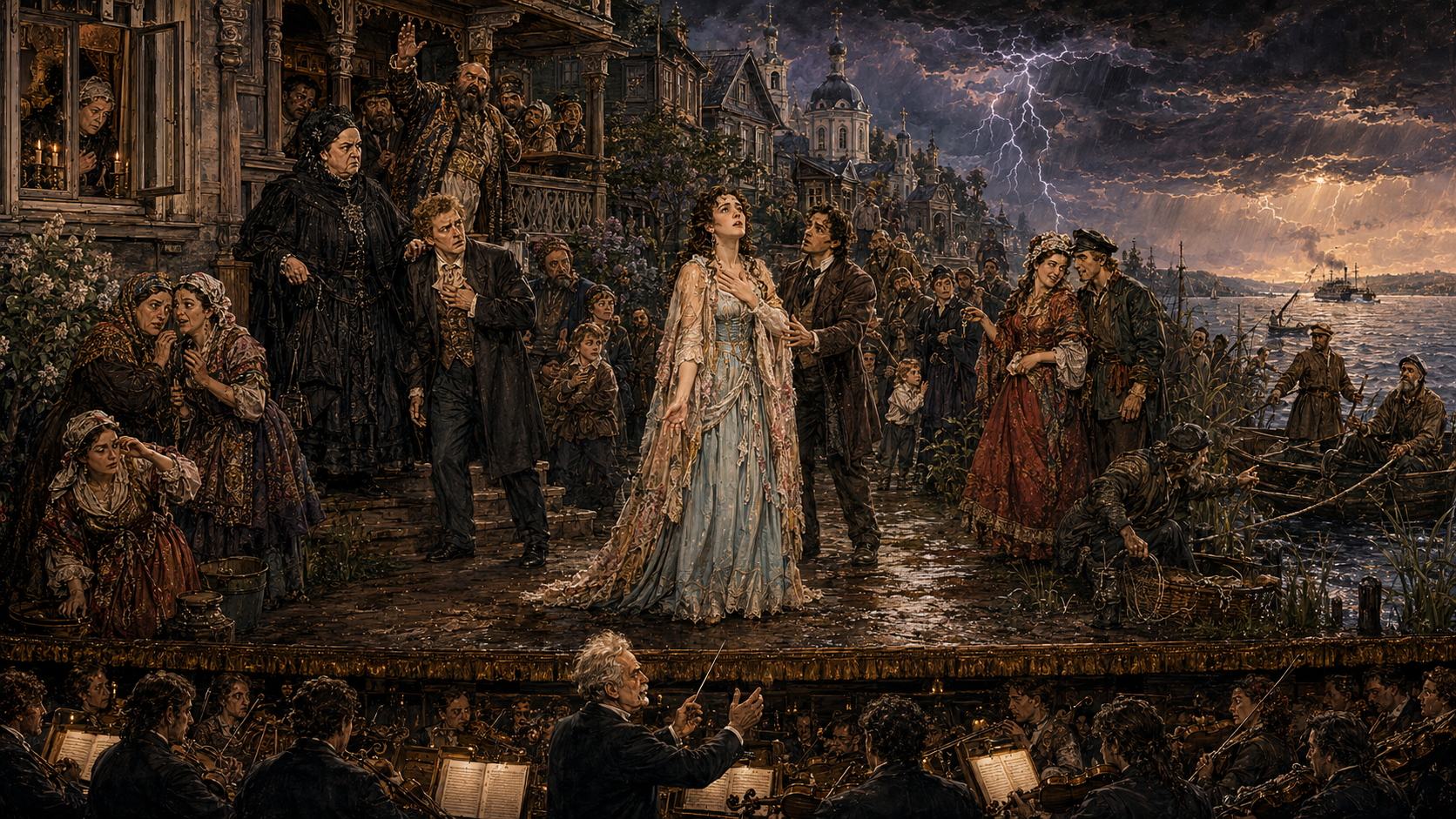

- Opera in 3 acts
- Composer: Leos Janáček
- Libretto: Based on The Storm by Alexander Ostrovsky
- First performed: National Theatre Brno, Czech Republic, 23rd November 1921, conducted by František Neumann
Characters
| Savël Prokofjevic Dikój, a merchant | Bass | Rudolf Kaulfus |
| Boris Grigorjevič, Dikój’s nephew | Tenor | Karel Zavřel |
| Marfa Ignatěvna Kabanová (Kabanicha), widow of a rich merchant | Contralto | Marie Hladíková |
| Tichon Ivanyč Kabanov, her son | Tenor | Pavel Jeral |
| Káťa (Katerina), Tichon’s wife | Soprano | Marie Veselá |
| Váňa Kudrjaš, a schoolteacher, chemist | Tenor | Valentin Šindler |
| Varvara, foster child in the Kabanov household | Mezzo | Jarmila Pustinská |
| Kuligin, friend of Vána Kudrjaš | Baritone | René Milan |
| Glaša, a servant | Mezzo | Lidka Šebestlová |
| Fekluša, a servant | Mezzo | Ludmila Kvapilová(-Kudláčková) |
| Woman | Ružena Horká | |
| Fisherman | Václav Šindler | |
| Drunkard | Josef Tupý | |
| Male and female citizens |
Setting: The Russian town of Kalinov, on the shores of the Volga River; the 1860s
Disclaimer: This is one of my shortest reviews, for which I apologise. I can’t speak Czech; I can’t look at Czech / English texts and follow a score at the same time (my brain is trying to do three different things at once, and folds in upon itself like a spatiotemporal anomaly); and there are no newspaper reviews. But this is a very good opera.
After far too many abstruse atonal German operas, it’s a relief to turn to Janáček, arguably the most skilful characteriser in the business, and one of the few twentieth century composers with a sense of beauty and a gift for melody. Kat’á Kabanová (let’s call it K.K. for short, to avoid those annoying apostrophes and aigus and alliteration) is a naturalistic, small-scale work, grounded in real life.
K. K. is a counterpart to Jenůfa: it concerns a love affair and the relationship between two women. The scene is a Russian town, dominated by the merchant class. The play concerns two families, both headed by domestic tyrants: Kabanicha, one of the biggest bitches in all opera, who is jealous of her daughter-in-law, Kat’á, and bullies her cruelly; and Dikój, who torments his nephew, Boris, who must stay with him, or lose his and his sister’s inheritance. While her husband is away, Kat’á has an affair with Boris; when her husband finds out, she drowns herself.
The score is through-composed, and it’s in no conventional key signature, but the music is often glorious. From the radiant yet ominous prelude (drums, drums in the deep!), Janáček creates a unique sound world, full of shimmering textures and unusual instrumentation. The orchestra glows: listen, for instance, to the music for the entrance of the Kabanovs, or Kat’á’s memories of going to church as a child. The love duet in Act II ranks with the best of Puccini’s; like the Luccan maestro, Janáček had a gift for soaring melodies that tug at the heartstrings.
Recordings
Listen to: Elisabeth Söderström (Kateřina), Petr Dvorský (Boris Grigorjevič), Naděžda Kniplová (Kabanicha), and Vladimir Krejčík (Tichon), with the Wiener Philharmoniker, conducted by Sir Charles Mackerras; London 1978. Decca.
 OPERA UNLEASHED!
I’m so excited to see you reviewing Janacek’s operas!
LikeLike