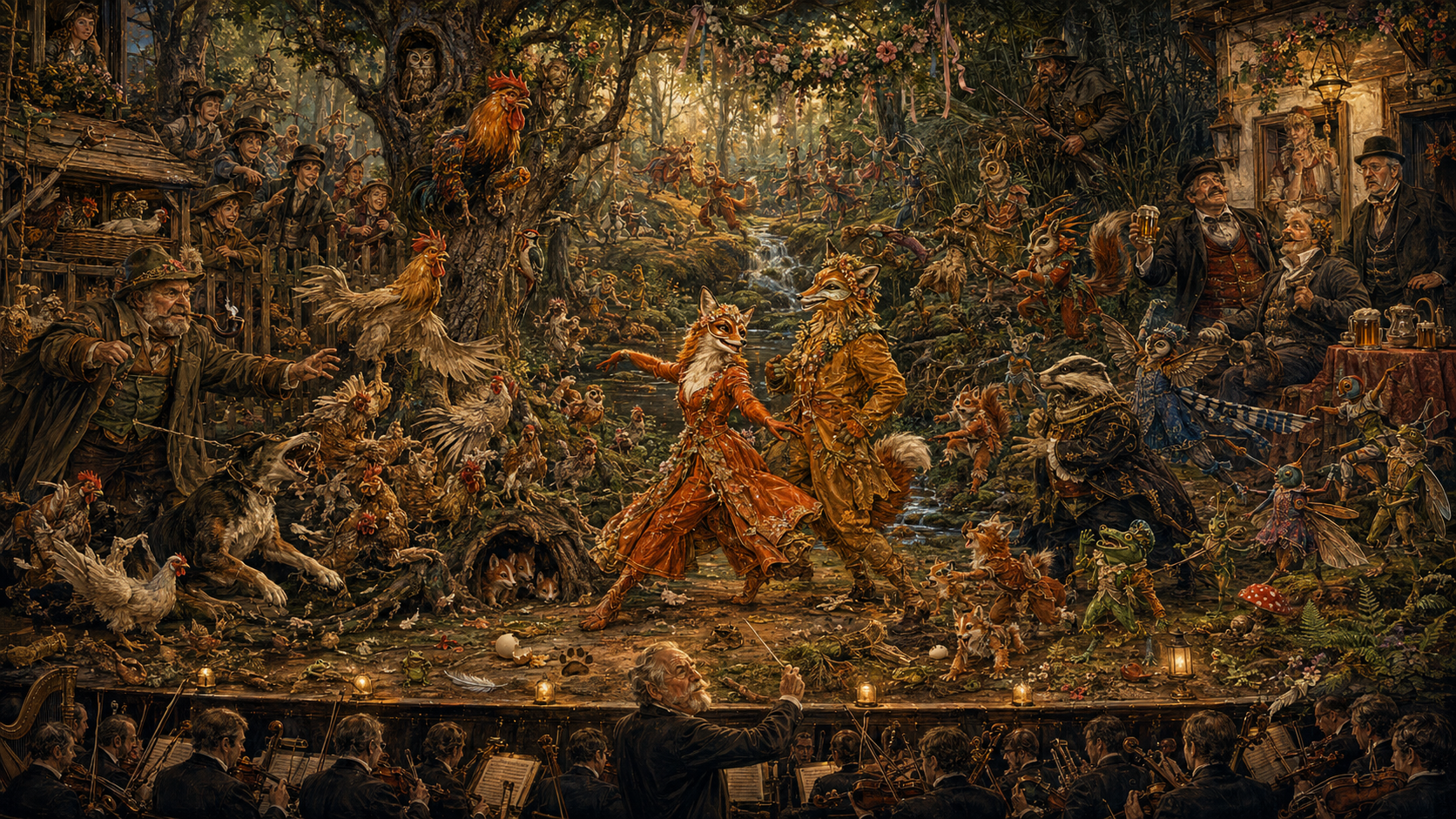

Příhody lišky Bystroušky
- Opera in 3 acts
- Composer: Leoš Janáček
- Libretto: After Liška Bystrouška (1920), by Rudolf Těsnohlídek
- First performed: National Theatre Brno, Czechoslovakia, 6 November 1924
Characters
| Forester (Revírník) | Baritone | Arnold Flögl |
| Forester’s wife | Contralto | |
| Schoolmaster | Tenor | Antonín Pelc |
| Parson | Bass | |
| Harašta, a poultry dealer | Bass | Ferdinand Pour |
| Pásek, an innkeeper | Tenor | Bedřich Zavadil |
| Sharp-Ears (Bystrouška) the Vixen | Soprano | Hana Hrdličková-Zavřelová |
| Mrs. Páskova, Pásek’s wife | Soprano | Jelena Jezicová |
| Gold-Stripe (Zlatohřbítek) the Fox | Soprano / mezzo | Božena Snopková |
| Young Vixen Bystrouška | Child soprano | |
| Frantík, Pepík’s friend | Soprano | Milada Rabasová |
| Pepík, Forester’s grandson | Soprano | Bozena Polaková |
| Lapák, a dog | Mezzo | Marta Dobruská |
| Rooster | Soprano | |
| Chocholka, a hen | Soprano | Vlasta Kubiková |
| Cricket | Child soprano | |
| Grasshopper | Child soprano | |
| Young Frog | Child soprano | |
| Fly | Child soprano | |
| Dragonflies, hedgehogs, squirrels, all sorts of forest creatures | Ballet | |
| Woodpecker | Contralto | |
| Mosquito | Tenor | |
| Badger | Bass | |
| Owl | Contralto | |
| Jay | Soprano |
The Cunning Little Vixen, famously, is an opera in which the main character is an animal: a wily, rather stroppy, fox. There are talking frogs, dogs, roosters and chickens, and dancing insects. However, this is not RSPCA-endorsed, and probably not suitable for small children, either. Animals are captured and tormented; they kill, and are eaten; they mate, breed, and die. But it’s not entirely a tragedy, either.
This “woodland idyll”, a “comedy with a sad ending”, as Janáček described it, is about the circle of life. (It’s more Bambi than The Lion King, though.). The vixen grows up from a naïve cub to a mother, then dies, shot by a poacher; he turns her into a muff and gives it to his lover; they soon get married. Meanwhile, the forester who captured the fox cub sits dreaming under a tree in the forest, and realises that generations of animal life go by in the space that a human lives a single life. He might look back with nostalgia at his past; a dried-up schoolmaster might regret unattained love; but the vixen, for all her short life, has arguably had a richer one than either. And yet, no matter how short or long the span, or how fulfilling the existence, Life, Nature, goes on, as it has for millions of years, and we are all connected. It is, Chisholm writes, “a pastoral symphony, a sincere and touching tribute to mother-nature, an almost Buddhistic hymn in praise of the basic unity of all living creatures”.
Vixen is perhaps Janáček’s most famous and most popular work, despite the obvious challenges that staging a work in which singers portray both humans and animals. Janáček based the story on cartoons serialised in the Czech newspaper Lidové noviny; his servant suggested the story to him.
He wrote one of his most lyrical and colourful scores, drawing on folk songs. Highlights include the mysterious, enraptured prelude, encompassing a kind of ballet of flies watched by a pipe-smoking badger; the vixen’s dream theme, a lovely rising and falling piece, related to the maestoso theme that closes the opera; the love duet for the Fox and Vixen, which Kaminski thought the equal of Tristan und Isolde’s; and the allegro wedding celebration with the voices of the forest.
Recordings
Listen to: Lucia Popp (the Vixen), with the Wiener Staatsopernchor and Philharmoniker, conducted by Sir Charles Mackerras, Vienna, 1981; Decca.
Works consulted
- Erik Chisholm, The Operas of Leoš Janáček, Oxford & New York: Pergamon Press, 1971
- Michael Ewans, Janáček’s Tragic Opéras, London : Faber & Faber, 1977
 OPERA UNLEASHED!
One of the most magically lyrical of all operas, one that wrings tears out of me every time. Somehow every bar of this score seems to evoke dappled sunlight in the woods, without monotony. Janacek requested the last scene be played at his funeral. He got his wish.
LikeLike