
- Opera in 2 acts
- Composer: Alberto Ginastera
- Libretto: Manuel Mujica Láinez
- First performed: Opera Society of Washington, Washington, D. C., USA, 19th May 1967, conducted by Julius Rudel
Characters
| PIER FRANCESCO ORSINI, Duke of Bomarzo, called Vicino | Tenor | Salvador Novoa |
| SILVIA DE NARNI, astrologer | Baritone | Richard Torigi |
| GIAN CORRADO ORSINI, father of Pier Francesco | Bass | Michael Devlin |
| GIROLAMO and | Baritone | Robert Gregori |
| MAERBALE, brothers of Pier Francesco | Baritone | Brent Ellis |
| NICHOLAS ORSINI, nephew of Pier Francesco | Tenor or alto | Joaquin Romaguera |
| JULIA FARNESE, wife of Pier Francesco | Soprano | Isabel Penagos |
| PANTASILEA, courtesan of Florence | Mezzo-soprano | Joanna Simon |
| DIANA ORSINI, grandmother of Pier Francesco | Contralto | Claramae Turner |
| ABUL, slave to Bomarzo | Silent rôle | |
| Messenger | Baritone | Nico Castel |
| Shepherd Boy | Boy soprano | David Prather |
| PIER FRANCESCO, GIROLAMO and MAERBALE as children | Voices of reciting children | Patricio Porras, Andres Aranda, Manuel Folgar |
SETTING: Bomarzo, Florence, and Rome in the 16th century.
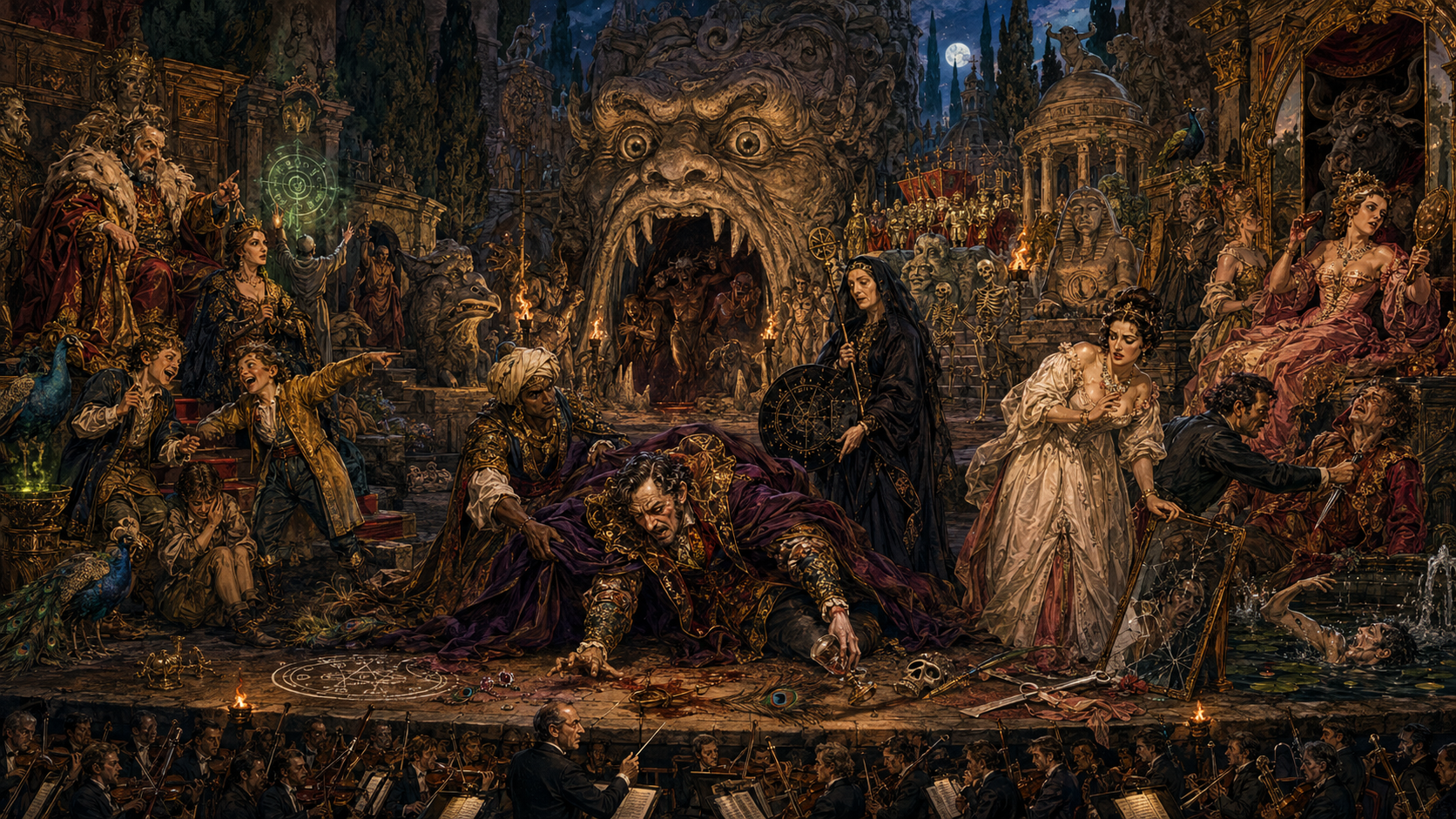
On his estate in Bomarzo, Pier Francesco Orsini (1523–83) created a garden of monsters. But this opera suggests that the duke himself – hunchbacked, murderous, and yearning for immortality – was the real monster.
“For me, Bomarzo is an anti-hero,” declared the Argentine composer, Alberto Ginastera. “He is a man of our times. The Renaissance was like ours. It too was an age of violence, of sex, of cruelty… Bomarzo struggles with sex, submits to violence, and is tormented by anxiety, the metaphysical anxiety of death.”
In the first scene, Orsini drinks what he believes is a potion of immortality; the stars have promised it. “For ages measureless to man, the Duke of Bomarzo will look at himself,” a chorus of demons sings. But that potion of immortality brings him death; it has been poisoned. Dying, collapsed on the edge of the Mouth of Hell (a sculptured stone monster in his garden), Pier Francesco sees the events of his life pass before his eyes – “Not the important ones, the Court, Battles and Wars – but the events of my secret life which, like the hump on my back, encumbered my soul.” He was hated by his father, and bullied by his brothers; he contrives to injure the first through black magic, allows one brother to drown, and has the other, whom he suspects, not without reason, of adultery, stabbed.
Sinister peacocks roam, harbingers of doom: emblems of Lucifer, they manifest in the park when he summons infernal spirits to wound his father, then shriek outside the boudoir of a Florentine courtesan. Mirrors, too, are important. He is frightened by his own reflection, rendering him impotent; he bans them from his estate; and smashes one at the end of Act I, on his wedding night. “Mirrors and copulation,” another Argentinian, Borges, once wrote1, “are abominable, since they both multiply the numbers of men.” Bomarzo’s likeness is a statue in his garden: “Minotaur, my brother, like me, disfigured, beautiful, and horrible, my hideous mirror, my brother.”
Bomarzo was Ginastera’s second opera. His first opera, Don Rodrigo (1964), starring Plácido Domingo, had been a hit in New York the previous year in its US première. But the Perón régime refused to stage it, on grounds of immorality.
Ginastera’s score is uncompromisingly modernist, written during his neo-expressionist period. “Bomarzo is of our time, and I had to compose music of our time,” the composer said. It combines post-Webernian 12-tone serialism with what Newsweek called “great gobs of explosive tone clusters, frequent aleatoric passages (random tones), and a microtonalism that divides and subdivides the chromatic scale”.
The prelude seems unearthly: the orchestra growls like one of Bomarzo’s monsters; there are passages of improvised percussion in free and discontinuous rhythm (using tom-toms, temple blocks, bongos, cow bells, and Chinese gongs, among other instruments); and a groaning vocalised chorus, issuing from the orchestra pit. The effect reminds me of Dudley Simpson’s scores for Doctor Who. (It is striking how much modernist or avant garde music I have heard via the BBC.)
Like most 20th century operas, however, there is little in the way of lyricism or melody; most of the opera is recitative. It is atmospheric, but ultimately oppressive, monotonous, and rather dreary. “Sometimes in the great halls of the castle, I am aware of a solemn shadow which accompanies me without a sound – terrible, silent, black, enormous and weightless,” Pier Francesco tells his grandmother at one point; he means the family ghost (the ancestral She-Bear), but it also describes the music.
But it is a divisive score. Robert Jacobson (Saturday Review) praised Ginastera’s “superb feeling for orchestral textures and instrumental scoring”; it was “music of strength, character, and dramatic impact”. “The so-called grayness which is often found in twelve-tone opera appears to be non-existent in the language of Ginastera. Instead, his score contains a wide range of colour, reflecting the life blood with the dramatic situations of the opera’s characters.” On the other hand, Conrad L. Osborne (High Fidelity) thought the work was theatrically effective, but it contained no memorable music. Two and a half hearings had left him with “almost nothing I can bring away, except a characteristic harmonic atmosphere and some fairly startling orchestral effects.” Bryan Townsend (The Music Salon) echoes those sentiments; while the work is dramatically effective, little of the music is memorable. “After a while bang and crash, fourths and irregular rhythms tend to mash together into the ear into a kind of sonic ‘grey goo’.” 12-tone music, he suggests, creates stasis.
Bomarzo, I would suppose, must be seen to be appreciated. It has much that would impress: gardens of stone monsters, several violent deaths, dancing skeletons, cabbalistic rituals, coronation ceremonies, and the like. In the wedding scene of Act I, the duke’s wife, his mistress, and his gay slave dance a galliard with him; the other dancers tear off their masks to reveal they too are his duplicates.
And it has elements that titillated its first audiences. It was called “the topless opera”: not only did the courtesan’s costume leave little to the imagination; not only, as Newsweek wrote, were “seduction, homosexuality and adultery [used] as common currency”; but the work “climaxed in a spectacular orgy in which dancers tore at each other’s skimpy body stockings in frenzied licentiousness”. When CBS published the LP, they advertised it as “the shocking new opera of ‘sex, violence, hallucination.’ – The New York Times”. Ideal publicity for the 1960s, when sex, scandal, and experiment were all the rage. (The musical Hair, which came out six months later, would go even further.) It was, however, too much for the Argentine government, which banned the opera until 1972.
Bomarzo, I imagine, loses much of its power on audio alone; nor is this a work I shall return to often. Nevertheless, the story casts a dreamlike – or nightmarish – spell. If ever I get the chance to see it, I will hurry to join the hunchbacked duke in his monstrous garden.
Recordings
Listen to: Original cast recording, conducted by Julius Rudel; Washington, 1967. CBS.
Works consulted
“New Works: In a Gloomy Garden”, Time, 26 May 1967.
“Not for Squares”, Newsweek, 29 May 1967.
Robert Jacobson, “Capital Ginastera in Washington”, Saturday Review, June 1967.
Conrad L. Osborne, “Ginastera’s Bomarzo – A Potent Brew of Calculated Theatrics”, High Fidelity, 1967.
Bryan Townsend, “Ginastera: Bomarzo”, The Music Salon, 8 May 2017.
- ‘Tlön, Uqbar, Orbis Tertius.’ ↩︎
 OPERA UNLEASHED!
I know of this opera. I’ve not heard or seen it, and I’m not sure I want to. Less because of the discordant music, mostly because it (and the novel on which it is based) so thoroughly trashes its subject. All other accounts make no mention of any physical deformity, and all paint Orsini as a rather model citizen, a patron of the arts, and with a respectable military career to boot. I’m not sure what the point of turning him into an ogre was, except to create a grotesque spectacle.
LikeLike
Well, Láinez thought he was the reincarnation of the duke.
LikeLike
I guess that would explain it 😉
LikeLike
“I found that things I had invented I had not intended. It was my own life. The Duke and I are one. It’s the defeat of death.”
An extreme example of the writer identifying himself with his subject?
LikeLike