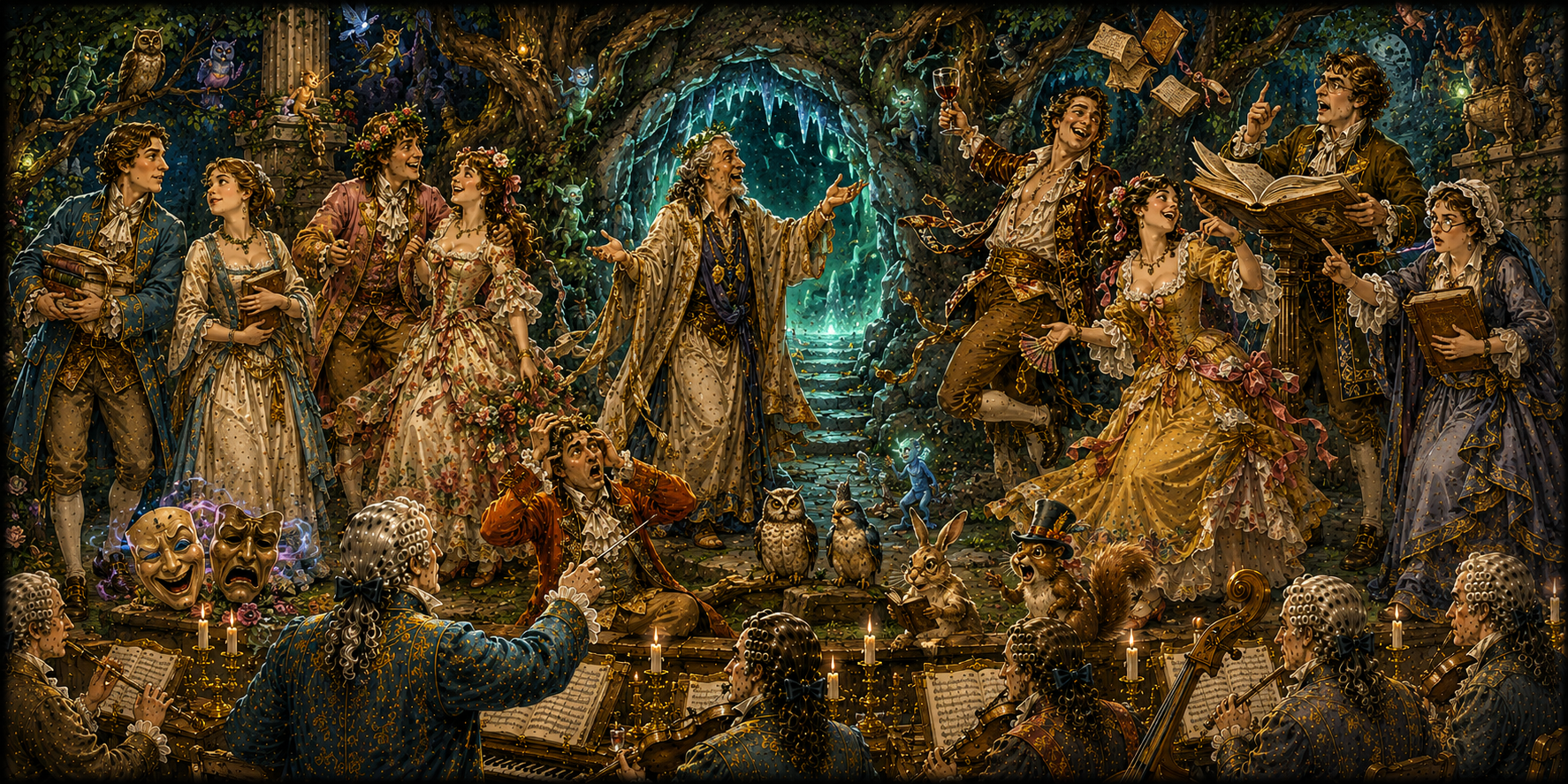

- Opera comica in 2 acts
- Composer: Antonio Salieri
- Libretto: Giovanni Battista Casti
- First performed: Burgtheater, Vienna, 12 October 1785
| ARISTONE, father of | Bass | Francesco Bussani |
| OFELIA and | Soprano | Nancy Storace |
| DORI, twins | Soprano | Celeste Coltellini |
| ARTEMIDORO, philosopher, reciprocated lover of Ofelia | Vincenzo Calvesi | |
| PLISTENE, reciprocated lover of Dori | Stefano Mandini | |
| TROFONIO, philosopher and mage | Francesco Benucci |
Setting: Boeotia, not far from the City of Livadia, partly in the country house of Aristone, and partly in the nearby woods, where the cave of Trofonio is located.
Among the bizarre extravagances imagined by the Greek mythologists, certainly one of the most singular is that of the cave of Trophonius, about which so many strange marvels are sung by fabulous antiquity, and above all, that of changing the mood of those who entered it. Thus, if someone was seen in a sad mood, it was proverbially said of him that he seemed to have come out of the Cave of Trophonius.
The opera’s Argomento
La Grotta di Trofonio was the epitome of Viennese opera, one admirer declared1, and it was one of Salieri’s greatest successes: 26 performances in the two years after its première (18 more than Figaro) and 30 productions throughout Europe over the next decade, from Germany, France, and Italy to Portugal, Denmark, and Poland. It was the first comic opera ever to have its score engraved.
Trofonius is a wizard, and his cave has the power to transform the personality of whosoever enters it. His victims are two pairs of young lovers, high-minded and high-spirited: Ofelia and Artemidoro, the serious couple, who enjoy philosophy, and the fun-loving Dori and Plistene. (According to the humours theory of the time, the former are phlegmatic or melancholy, and the latter sanguine.)
Abbate Casti’s handling of the device is rather schematic. In Act I, the young men enter the cave and are transformed; one throws away his philosophy, determining to live life as it comes; the other rejects his wasted youth, and becomes a devotee of Plato, horrifying his fiancée, since platonic love is not to her taste. In Act II, the men re-enter the cave, and, thanks to its properties, return to normal. Now it is the ladies’ turn to suffer its effects. The bluestocking becomes a flapper, and vice versa. All is set right at the end.
It is more of a misadventure, an anecdote, than a comic plot; there are no other complications, and, unusually for opera, no other barriers to the couples’ love. Indeed, the father, Aristone, is wholly benevolent, and from the outset encourages his daughters to marry whom they please.
Count Karl Zinzendorf, a Viennese operagoer, thought the story lacked artistry: “There are no décors, forever the garden, forever the grotto, forever the transmutations.”2 But he praised the “charming music”. The plot’s weaknesses, Braunbehrens3 maintains, are compensated by the wealth of musical ideas, blending styles (including accompanied recitatives and arioso parlando).
Slight though the plot might be, there are some wonderful things in the music. If we must compare Salieri with Mozart, it’s on a par with Così fan tutte. Act I starts right off the bat with one of the most beautiful numbers in the score: Aristone’s trio with his daughters, “Mie care figliuole”, tenderly depicting familial affection with some lovely unison singing. A clever quartet, “Il diletto che in petto mi sento”, contrasts the four young people: the extroverts’ singing and laughter annoys the introverts, who want to talk about the philosopher Theophrastus. Shortly before his transformation, Artemidoro has an aria, “Di questo bosco ombroso”, reflecting on the pleasures of solitary strolls in a tone of hushed rapture.
Act II has two excellent trios: in “Venite, o Donne” (andante), Trofonio suavely persuades the two girls to enter his cave; in “Ma perchè in ordine il tutto vada” (allegro), the three other men search for them; Plistene gets plenty of lively patter singing. The finale contains a beautiful quartet and a Rossinian concertato section as the family politely reject the wizard’s invitation to enter his cave and meet his demons, and instead scarper.
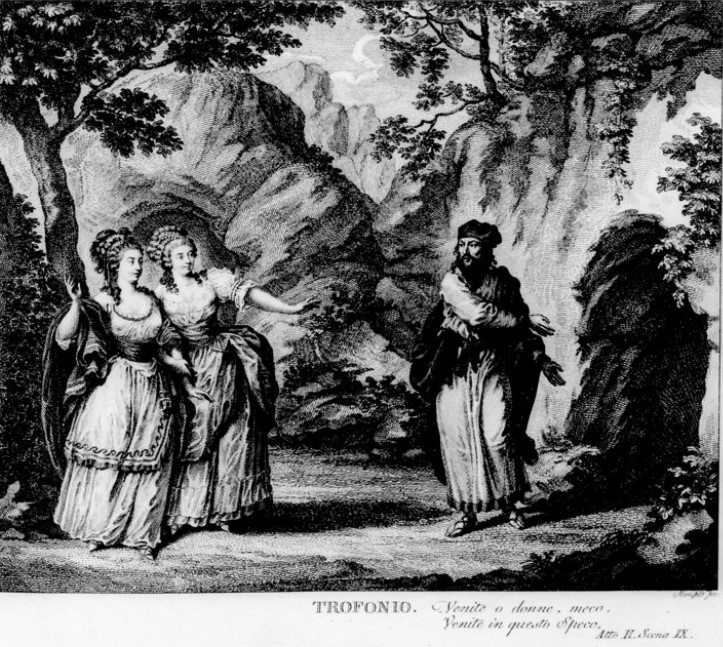
The score contains many short arias and duets, several less than two minutes long, some barely a minute (Aristone’s “Orsù già compresi” and Artemidoro’s “Evviva la gioja” in Act I; the two young men’s duet, Trofonio’s “Questo magico arbituro”, Doni’s “La ra la” in Act II). It is a Gluckian approach: enough to establish a mood or a character point, but serving the drama, rather than (as in Mozart) the play providing vessels for music.
Grotta was recorded by Christophe Rousset in 2005; that recording is as rare as hen’s teeth, and fetches several hundred dollars online. Fortunately, the music is on YouTube and the booklet on the Internet Archive. While not quite as good an opera buffa as La scuola de’ gelosi, those interested in Salieri should visit the cave. While unlike to turn hedonists into philosophers, those in a melancholy mood might find it changes their spirits.
Recordings
Listen to: Olivier Lallouette (Aristone), Raffaella Milanesi (Ofelia), Marie Arnet (Dori), Nikolaï Schukoff (Artemidoro), Mario Cassi (Plistene), Carlo Lepore (Trofonio), with Les Talens Lyriques, conducted by Christopher Rousset, Lausanne, 2005. Ambroisie AMB 9986.
 OPERA UNLEASHED!
This recording is absolutely delightful. Salieri was a great composer of opera, despite what Peter Schaeffer said about him. More adventurous and versatile than Mozart, even if he didn’t have the best librettos with which to work. Rousset’s recording of Les Danaïdes is also terrific. I’m less impressed with Tarare and Les Horaces, but this is really the composer’s fault. The comedies are great though, especially Falstaff and La scuola de’gelosi.
LikeLike
Rousset really has done excellent work resurrecting Salieri; we have three French operas, Armida, and soon Cublai, gran khan de’ Tartari. (His Lully recordings are good, too – less staid than Christie’s.) I have Falstaff (Schwetzingen, with John del Carlo, a terrific Mustafà) playing in the background; it’s very attractive.
More adventurous and versatile than Mozart? Why are you less impressed with Tarare and Les Horaces? I’m a fan of the former.
I thought of auditioning last year for a performance of Amadeus, but I would have spent the entire rehearsal and performance complaining that Salieri had been libelled. I have met plenty of people who have seen the film and believe that Salieri poisoned Mozart. Tchah!
LikeLiked by 1 person
Mozart died young and while he had a traceable evolution, it wasn’t nearly as long and varied a journey as Salieri’s. Mozart’s operas are all very much in the recitative-aria format, whether he was writing Opera Seria, comedies or vaudville. While he did conceive and write scenes as units, they don’t really follow the forward-thinking Gluckian model that Salieri did for some of his operas. Not that I’m 100% on board with that model, but when it works it can make for some riveting music theater.
I need to listen to Tarare again. I confess that I re-read your entry on that opera before I wrote what I did and thought you would probably question me about it. My impression was that at the time I heard it I found the score to be a little schitzophrenic and fragmentary. As through-composed as an 18th century opera could be, but without natural flow. I found it musically frustrating, without even considering the drama it sought to depict. Les Horaces even more so. So my comment was unfair.
Another Salieri opera that is fun to hear is La Fiera di Venezia. The only drawback to its only recording is the continuo playing is rather elaborate and intrusive. A few years ago there were some polarizing recordings of Mozart operas that suffered from the same issue, and I wonder if the continuo player was the same person. Wayward improvisation, references to broadway musicals and pop songs. I admired the unique approach and creativity, but it was distracting.
LikeLike
Oh, shoot. Sorry, it’s been a long Holy week, and I’ve sung five services and am not thinking straight. The continuo playing I was thinking of is on the recording of the School for Jealousy. It’s a great comedy, and I love it. La Fiera di Venezia is a wonderful comedy too.
LikeLike