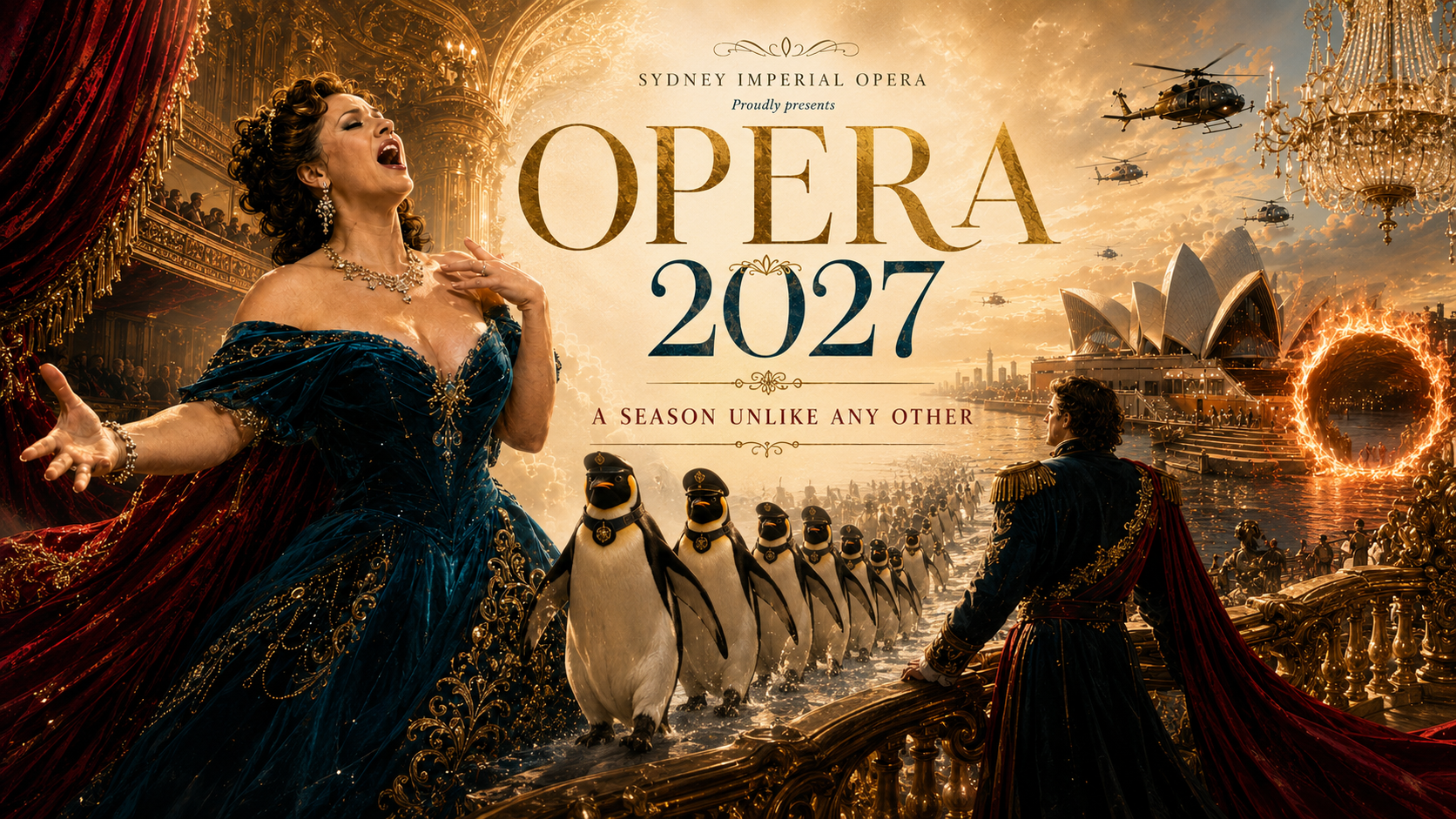

Opera houses around the world are complaining of shrinking audiences and dwindling finances, while audiences themselves are increasingly bored with a small number of warhorses in rotation, often dressed up in Regietheater productions to make them look fresh, novel and confronting. Opera is in a crisis, it has been said. Obviously something radical is called for.
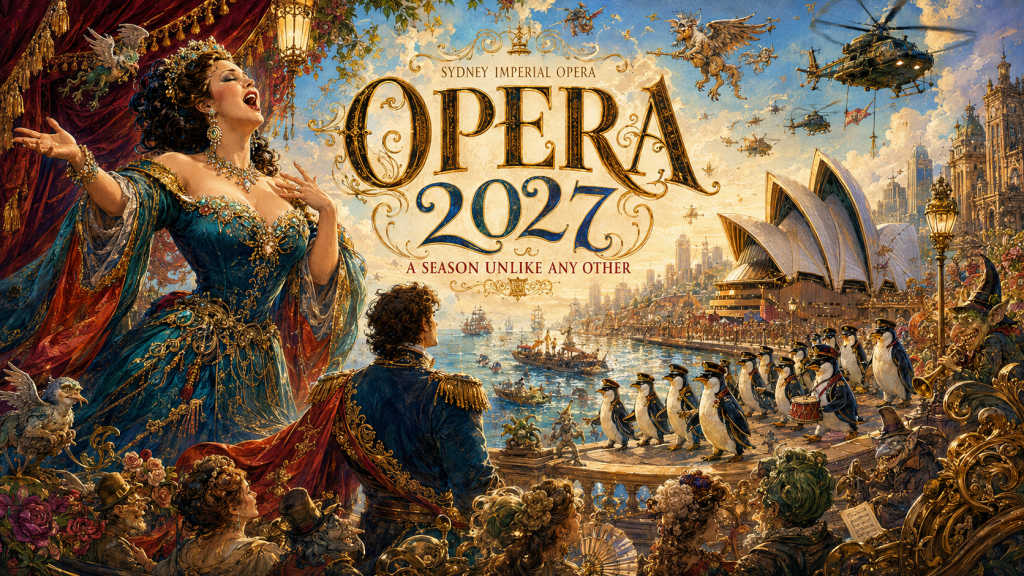
To rekindle interest and excitement in this moribund artform, we propose the following season:
- Cesti: Il pomo d’oro (1668). A legendary monument of 17th-century court spectacle returns in all its splendour, presented uncut. No intermission.
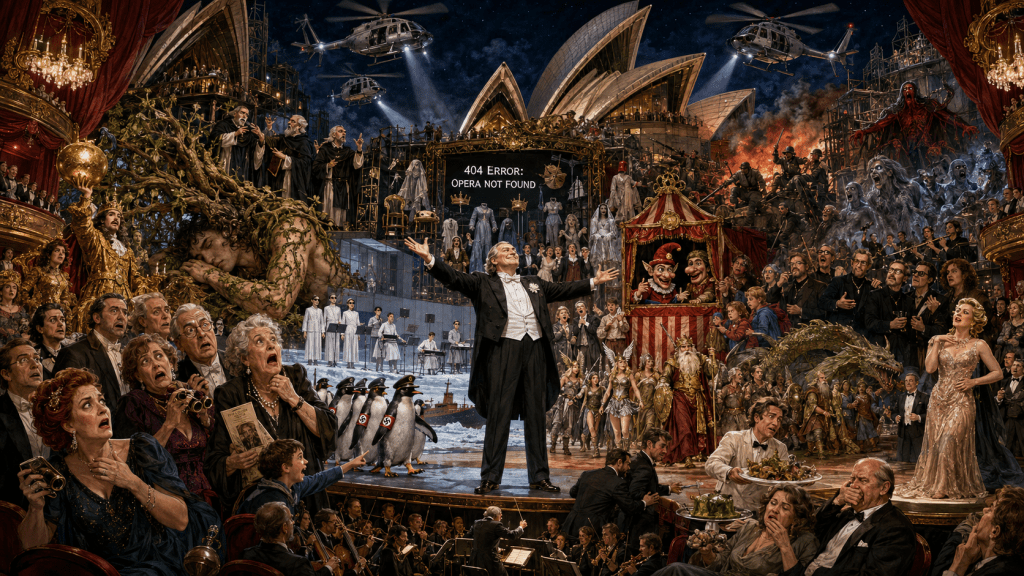
- Lully: Atys (1676). Five acts of French baroque tragedy: the high point is the hero falling asleep in the middle of the opera before he is turned into a tree.
- Winter: Maometto (1817). The season’s accessible Italian opera, presented in a spirit of ecumenical
outrageoutreach and inter-faith dialogue. - Schumann: Genoveva (1850). For generations, audiences have wondered why Schumann only wrote one opera; now they can discover the reason for themselves.
- Pfitzner: Palestrina (1917). A four-hour discussion about sixteenth-century church politics, the metaphysical destiny of German art, and writing a Mass.
- D’Indy: La légende de St Christophe (1920). Drame anti-Juif.
- Schoeck: Penthesilea (1927). Mythic violence for people who found Elektra too relaxing.
- Magnard: Guercœur (1931). By the French Bruckner, as exciting as that sounds.
- Thomson: Four Saints in Three Acts (1933). Text by Gertrude Stein.
- Egk: Peer Gynt (1938). Hitler and Goebbels liked it.
- Schoenberg: Moses und Aron (1957). They probably wouldn’t have.
- Nono: Intolleranza (1961). Nono, or just plain no? Nanette not included.
- Zimmermann: Die Soldaten (1965).
- Birtwistle: Punch and Judy (1968). FAMILY MATINEE.
- Penderecki: Die Teufel von Loudun (1969).
- Glass: Einstein on the Beach (1976). With knee plays and knee tremblers.
- Kirchner: Lily (1977).
- Messiaen: Saint François d’Assise (1983).
- Turnage: Greek (1988). Sophocles in East London – an invigorating evening for anyone who considers Punch and Judy insufficiently confrontational.
- Reynolds’s Sands of Time (1993). Presented for the first time as a full-price flagship event.
A concession to popular taste: A special mid-season addition in response to audience feedback
We have heard concerns that the season lacks familiar composers.
Audiences love Mozart. So we are delighted to present Mozart.
- Mozart: Die Schuldigkeit des ersten Gebots (1767). A rare opportunity to encounter the eleven-year-old composer before Figaro, Don Giovanni, Così fan tutte, Idomeneo, The Magic Flute, or indeed most of the reasons audiences ask for Mozart.
We have heard you. You want La Bohème.
- La Bohème – by Leoncavallo.
You wanted Puccini.
- Puccini: Edgar (1889). Specially translated into Swahili for the occasion.
You wanted The Barber of Seville.
- Il barbiere di Siviglia – by Paisiello.
Some of you wanted Ernani.
- Ernani – by Bellini: in fragments
We were criticised for neglecting the standard repertoire. We listened.
(Which is technically true, in the same way that dropping a piano on someone from a third-storey window is technically giving them music.)
The season resumes
- Zillig: Das Opfer (1937). Set at the South Pole; features the march of the Nazi penguins.
- Wayditch: Eretnekek [The Heretics]. WORLD PREMIÈRE OF THE GUINNESS WORLD RECORD HOLDER OF THE WORLD’S LONGEST OPERA. More than 8 hours long, and changes scenes every few minutes. The piano reduction is 1,531 manuscript pages in four volumes. The orchestral score is approximately 2,850 pages in four volumes. Sung in Hungarian.
- Stockhausen: Licht (1981-2012). The entire thing: seven days, seven operas, and four helicopters.
Oh, and we’re going to remove the roof of the Sydney Opera House to put the helicopters in. We’ll put it back on again. Probably.
Special presentations!
- Peri: Dafne (1598)
- Mozart: Der Diener zweier Herren
- Meyerbeer: La jeunesse de Goethe
- Wagner: Jesus von Nazareth
- Verdi: Re Lear
- Puccini: Marie Antoinette
The audience takes their seats. The house lights dim. The surtitles read: 404 ERROR: OPERA NOT FOUND. The house lights go up again. The audience files out again. A meditation on absence, unrealised possibility, and the instability of the operatic canon.
At least these ones exist
A dozen of the most notorious flops in opera history, including:
- Massenet: Bacchus (1909) and
- Barber: Antony and Cleopatra (1966).
Bold political commentary!
- Mascagni: Nerone (1935)
- Malipiero: Giulio Cesare (1936)
- Marinuzzi: Palla de’ Mozzi (1932)
- Porrino: Gli Orazi (1941) – Italian opera for fascists.
- Kosaku Yamada: Kurobune [The Black Ships] (1940) – Japanese imperialist opera
- Dzerzhinsky: The Quiet Don (1936) – praised by Stalin
- Muradeli: The Great Friendship (1947) – it wasn’t
A special gala event featuring Renée Fleming
(or Joyce DiDonato, Anna Netrebko, or Cecilia Bartoli)
- Deraco: Taci (2018). FOR ONE NIGHT ONLY. Premium stalls: $495, A-reserve: $395, meet the artist package: $750.
Climax
- Wagner: Der Ring des Nibelungen (1869-76). All of it. In one sitting. No interval; re-entry not permitted. As Wagner intended, the opera house will then be burnt down.
This season moves beyond the outdated expectation that opera should provide enjoyment. No concession, no remission, sometimes no intermission.
For your culinary pleasure, the restaurant will serve the black broth of the Spartans, hákarl, durian, casu marzu, and a re-enactment of the 1870 Paris Zoo banquet – the pièce de résistance is le chat flanqué aux rats. (We were advised we could not serve polar bear liver pâté or thịt chó.) You may enjoy these with a glass of osarge, snake wine, or baby mice wine.
For your listening pleasure and relaxation, the music of Xenakis, Penderecki’s Threnody, and Avraamov’s Symphony of Sirens will play in the lobby.
Bookings now open.
 OPERA UNLEASHED!