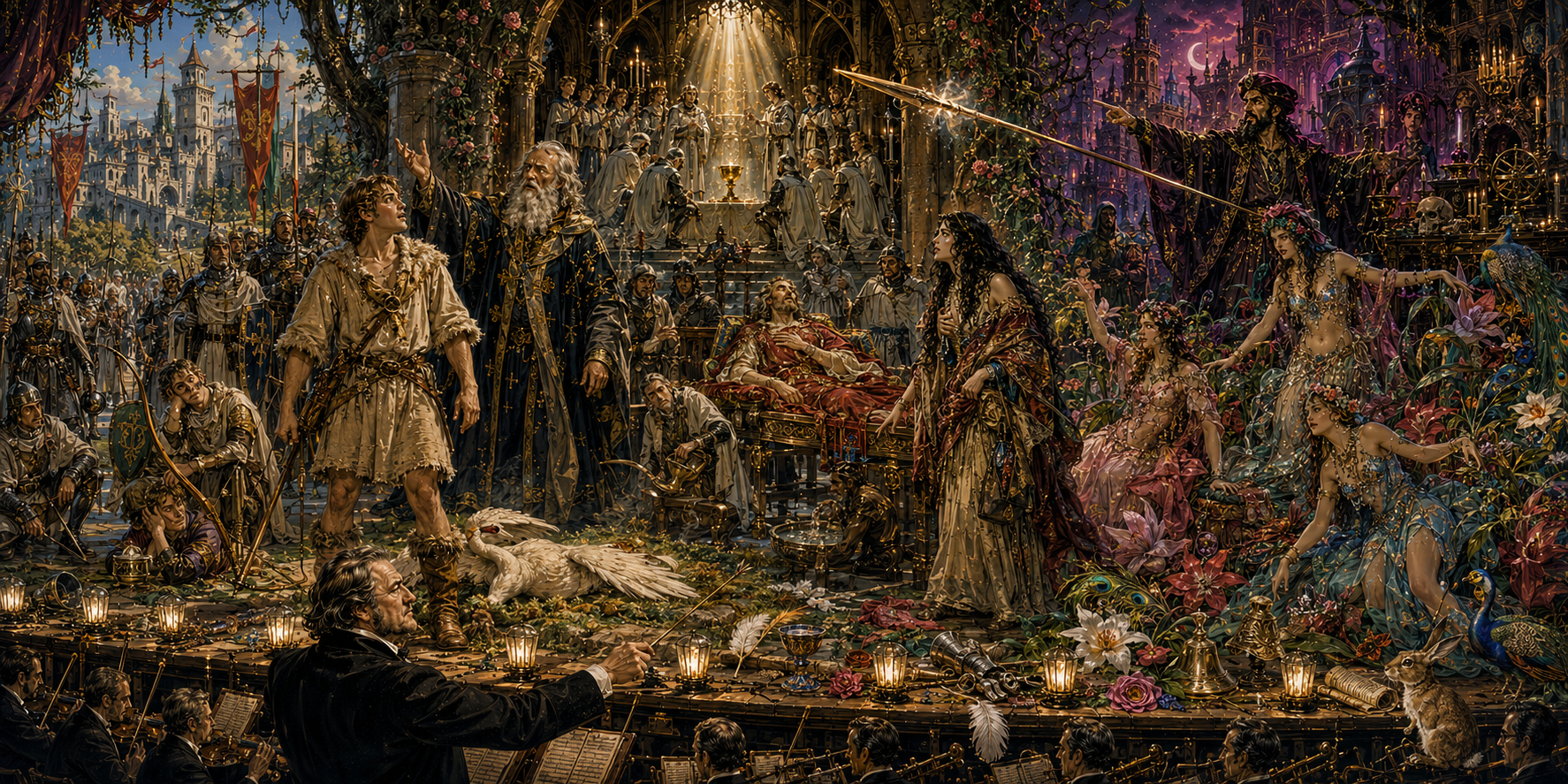

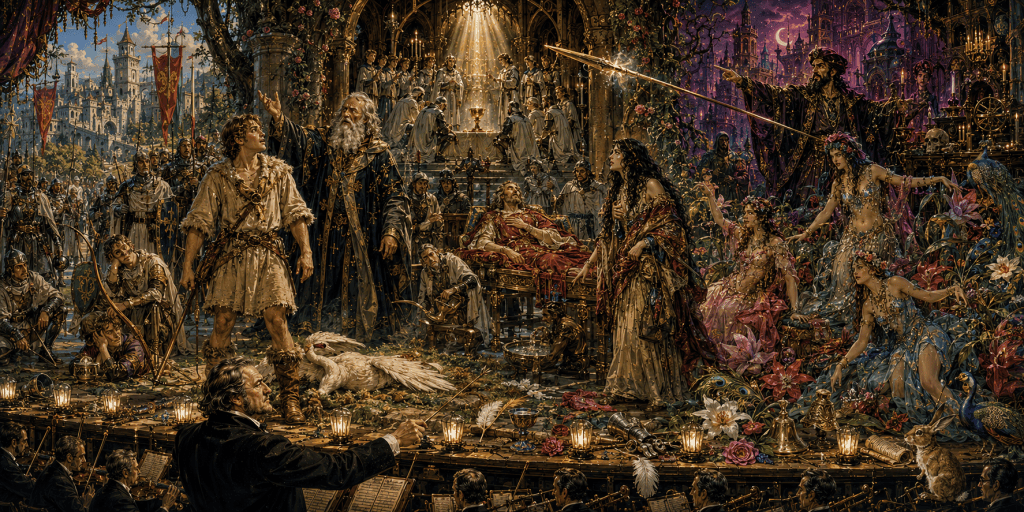
- Bühnenweihfestspiel in 3 acts
- Composer / libretto: Richard Wagner
- First performed: Bayreuth Festival Theatre, Bayreuth, Germany, 26 July 1882, conducted by Hermann Levi
Characters
| AMFORTAS, King of the Kingdom of the Grail | Baritone | Theodor Reichmann |
| TITUREL, a retired king of the Kingdom of the Grail, Amfortas’s father | Bass | August Kindermann |
| GURNEMANZ, an elderly knight of the Grail | Bass | Emil Scaria |
| PARSIFAL, a youth | Tenor | Hermann Winkelmann |
| KLINGSOR, an evil magician | Bass-baritone | Karl Hill |
| KUNDRY, a messenger of the Grail | Soprano / mezzo | Amalie Materna |
| Two Grail Knights | Tenor Bass | Anton Fuchs Eugen Stumpf |
| Four squires | Soprano Alto Tenor Tenor | Hermine Galfy Mathilde Keil Max Mikorey Adolf von Hübbenet |
| Klingsor’s flower maidens | Three sopranos Three contraltos | Pauline Horson Johanna Meta Carrie Pringle Johanna André Hermine Galfy Luise Belce |
| Voice from Above | Contralto | Sophie Dompierre |
| Knights of the Grail, squires, flowermaidens |
Place of the Action: In the domain and in the castle of the Grail’s warden “Monsalvat”; country in the character of the northern mountains of Gothic Spain. – Afterwards, Klingsor’s magic castle on the southern slope of the same mountains, supposed to face Arabian Spain.
Persiflage, n.: light raillery or mockery; bantering talk; a frivolous or mildly contemptuous manner of treating any subject.
Parsifalage, n.: the opposite of all that. (There is no frivolity in Parsifal, although there is a great deal of laughter – hysterical laughter, and at the suffering of ‘the Redeemer’.)
“You mean the Grail also comes into this?” asks the bemused Belbo in Umberto Eco’s Foucault’s Pendulum, listening to a harangue linking Wolfram von Eschenbach, the Templars, the Cathars, the Nazis, the druids, the Golden Fleece, Celtic and Aryan symbols, the elixir of the alchemists, the Secret Masters of the World hiding in Tibet, and Stonehenge.
“O basta là,” Belbo said. Only another child of Piedmont could have understood the spirit in which this expression of polite amazement was uttered. No equivalent in any other language or dialect (dis donc, are you kidding?) can convey the apathy, the fatalism with which it expresses the firm conviction that the person to whom it is addressed is, irreparably, the product of a bumbling creator.
Ch. 20
Parsifal, Wagner’s last opera – sorry, stage consecration festival play – is madly mystical and esoteric, if not occultist. It draws on Christianity, Buddhism, Schopenhauer, and Arthurian legend, swimming in a sea of blood, suffering, sin, guilt, redemption, and reincarnation, with various wildfowl and amorous vegetation.
The characters are a holy fool, so stupid he doesn’t even know his own name; an elderly knight (bass) who exposits for two-thirds of the opera; a Fisher King with a bath fixation; the disembodied voice of his father; another disembodied voice, from on high; a schizophrenic witch, the reincarnation of Herodias and Gundryggia; and a castrato sorcerer who sings bass-baritone.
The opera is virtually plotless, with far more backstory and exposition than action; it is slow, lugubrious, and entirely lacks drama. The knights of Montsalvat guard the Holy Grail, which caught Christ’s blood, and the Spear, which pierced his side on the Cross. The evil sorcerer Klingsor has stolen the Spear, and the guardian of the Grail, Amfortas, suffers from an incurable wound. The only one who can heal him and recover the Spear is the pure fool, made wise through compassion: Parsifal. Having seen the knights worship the Grail, and the suffering of Amfortas, Parsifal’s wanderings take him to Klingsor’s castle, where Kundry tries to seduce him. She was cursed for laughing at Christ on the Cross. Parsifal resists her charms, recovers the stolen Spear, and defeats Klingsor. Cursed by Kundry to wander for years, he eventually finds his way back to the castle, and there he heals Amfortas. Kundry, released from her curse, dies, and Parsifal becomes the new king.
Tchaikovsky1, for one, thought this story had nothing to do with human beings. “What really astonishes me is the earnestness with which this over-philosophizing German illustrates by means of music the most incredibly stupid subjects. I mean, who could possibly be moved by the plot of Parsifal, where, instead of people with temperaments and feelings that we are familiar with, we are shown various fairytale figures who might perhaps be suitable for embellishing the content of a ballet, but never that of a drama? I am surprised that anyone can listen, without succumbing to laughter, or rather to boredom, to these figures’ endlessly long monologues about the various spells from which all these Kundrys, Parsifals, etc. are suffering!!! I mean, is it possible to empathize with them, to be filled with heartfelt sympathy for them, to love and hate them? Of course not — because their sufferings, feelings, triumphs or failures are utterly alien to us. And what is alien to the human heart cannot be the source of musical inspiration.”
But what, if anything, does it mean? It’s about redemption and compassion, that much is clear. Shooting swans is frowned upon; so too is laughing at the Redeemer’s agony. To some degree, it is about the moral education of Parsifal, a young man who at first does not know what “good” or “bad” mean; by the end, he has become enlightened, a bodhisattva, “a pure fool made wise through compassion”. In contrast, Amfortas and Klingsor yearn for purity: Amfortas’s blood quickens, and he responds to the sinful world outside Monsalvat; Klingsor, tormented by impure thoughts, emasculated himself. Parsifal redeems one, and destroys the other.
Beyond that… Hundreds of articles have been written about the meaning of Parsifal; there is even a dedicated website. Is it the rejuvenation of Christianity? Wagner declared he was “inspired to write this in order to preserve the world’s profoundest secret, the truest Christian faith, or rather, to awaken that faith anew”. Is it a synthesis of Buddhism and Christianity? Is it spirituality for a post-religious age, reconciling man to nature? Is it about ethical, humanist Jesus replacing the tyrannical Abrahamic / Germanic war god king? Is it about rescuing Christianity from the Jews? (Jesus, according to Wagner, was, of course, Greek, not a Hebrew.) Is it about the masculine (the spear / lingam) unified with the feminine (the cup / yoni)? Is it about Schopenhauerian renunciation and self-denial overcoming the will, through compassion for others? Is it an animal rights and vegetarian tract? Is it pacifist? Nazi? Pro-gay? Anti-sex? The secret bloodline of Christ? O basta là!
Parsifal’s saving grace – what redeems it, if you will – is that it contains some of Wagner’s most beautiful music, meditative and transcendental. The score reminds me of a forest: shafts of light fall through the branches, even in the darkest, most overgrown glades. The musical interest, however, is almost entirely in the orchestra, not in the singing, which is declamation and arioso. Tchaikovsky, a bloke who knew a bit about music, wondered: “If in an opera the singers don’t sing, but merely utter, accompanied by deafening thunder from the orchestra, various hastily grafted-on, colourless successions of notes against a background of a splendid, but incoherent and formless symphony, what kind of opera can that possibly be?!”
The slow prelude is hushed and rapturous, with passages that shimmer. Much of the score is derived from the Grundthema, the A flat phrase with which the prelude begins. It is somehow Brucknerian.
Act I consists of the knight Gurnemanz delivering exposition (Wagner was a great believer in Tell, Don’t Show) and a Mass. Mark Twain was bored: “Gurnemanz … stands on the stage in one spot and practices by the hour, while first one and then another of the cast endures what he can of it and then retires to die.” Nevertheless, “Titurel der fromme Held”, describing how the Grail came to Monsalvat, is effective, and the little quartet where the squires sing the prophecy of the pure fool is magical. The Transformation Music is majestic; we hear the bells of the castle, a surge of the theme of Amfortas’s Suffering, and then we are into the knights’ splendid chorus “Zum letzten Liebesmahle”. Et Ô ces voix d’enfants, chantant dans la coupole!
In fact, Act I, though almost twice as long as the other acts, and by itself as long as a good many self-respecting operas, holds the attention.
The other two acts, however, do not. Act II, set in Klingsor’s castle, goes on rather: the flower maidens try to deflower Parsifal; Kundry tries to seduce Parsifal by talking about his mother, sin, and the Redeemer; and Parsifal wards off Klingsor by seizing his potent spear and shaking it. There is no memorable music. (No, not even the flower maidens’ “chorus”.) The key structure is modelled on Act III of Meyerbeer’s Robert le Diable, where the diabolical Bertram summons undead nuns to seduce his son.
Act III is very tedious indeed. Gurnemanz, by now senile, finds Kundry half-dead in a bush; she washes Parsifal’s feet; and Parsifal brings the spear back to Monsalvat. The Good Friday music is a relief from Gurnemanz’s blethering. Parsifal – and Wagner’s operas – end triumphantly with “Nur eine Waffe taugt”.
Wagner intended that Parsifal should only be performed at Bayreuth; the première was, Le Ménestrel [6 August 1882] commented, like a pilgrimage to Lourdes. Mahler and Hugo Wolf (“the most beautiful and sublime work in the whole field of Art”) were enthusiastic. Later, Alban Berg, Sibelius, and Debussy (despite reservations about the story) raved about the music.
Others, however, were critical. Eduard Hanslick “discern[ed] sterility and prosaicism, together with increasing longwindedness”. Tchaikovsky found Parsifal tedious: “In spite of the mastery of genius which it shows, what falseness and nonsense there is in the whole monstrous thing!” Nietzsche thought that Wagner had sold out to the Christians: “Parsifal is a work of perfidy, of vindictiveness, of a secret attempt to poison the presuppositions of life – a bad work. The preaching of chastity remains an incitement to anti-nature: I despise everyone who does not experience Parsifal as an attempted assassination of basic ethics.”
Wagner died half a year after the première, in February 1883. Parsifal was not allowed to be performed outside Bayreuth until the 1920s. (The New York Met, however, broke the embargo in 1903, infuriating Wagner’s widow, the formidable Cosima.) Despite its great length and tedium, and absence of drama and (after Act I, for the most part) music, every opera house that could hurried to stage Parsifal. Darius Milhaud, however, reported that Parsifal “sickened [him] by its pretentious vulgarity. I did not realise that what I felt was merely the reaction of a Latin mind, unable to swallow the philosophico-musical jargon and the shoddy mixture of harmony and mysticism in what was an essentially pompous art.”
Galahad never had a gal.
He preferred the Holy Grail
To the kisses of a frail.
Which raises the question: How did Parsifal beget Lohengrin? (He wasn’t the marrying kind, and shows no romantic interest in the only woman in the opera.) Immaculate conception? Union with the Grail?
Recordings
Listen to: René Kollo (Parsifal), Gottlob Frick (Gurnemanz), Dietrich Fischer-Dieskau (Amfortas), Christa Ludwig (Kundry), Zoltan Kelemen (Klingsor), and Hans Hotter (Titurel), with the Vienna Philharmonic, conducted by Sir Georg Solti, 1972. Decca.
Watch: Waltraud Meier (Kundry), Siegfried Jerusalem (Parsifal), Bernd Weikl (Amfortas), Franz Mazura (Klingsor), and Kurt Moll (Gurnemanz), with the New York Metropolitan Orchestra, conducted by James Levine, New York, 1992.
- Letter 2545 to Nadezhda von Meck, September 1884, Tchaikovsky Research. ↩︎
 OPERA UNLEASHED!
I was hoping you would end your foray into Wagner with his greatest, Meistersinger. Although appropriate for Good Friday, Parsifal IS a snoozefest. Truth be told, Meistersinger is the ONLY Wagner opera I’ve not fallen asleep during. Like Tristan before it, hours pass before something happens. When it finally does, it’s not that impressive. Even his most popular Ring opera, Walküre, drags. I remember falling asleep at the beginning, waking up and asking if I missed anything. “Not really. Oh, it’s Spring.” “That’s it?” “Pretty much.”
But Meistersinger is different somehow. Maybe because the drama itself is compelling, being about actual human beings rather than pious knights, gods and goddesses. And the score is just brilliant, with dialogue that goes along at a natural clip. We never have to wait for six pages while someone sings, “Oh hi Parsifal, how are you?” At four and a half hours, it doesn’t seem too long. I wouldn’t call it a comedy, but it is a perfectly relatable human drama with plenty of warmth and good tunes.
Now, when are you going to tackle the greatest opera ever written? (Le prophéte)
LikeLike
I do intend to write about Meistersinger, but I’m Wagnered out! Meistersinger is Wagner’s most enjoyable opera, although even then it’s easy to get wrong. I watched the 2014 Met staging last year; it’s a ponderous production, and Johan Botha was lumpen. The best Meistersinger I’ve seen, actually, is Opera Australia’s 1988 production, with Donald McIntyre as Sachs; it’s an intimate production, it moves swiftly, and the characters are sharply portrayed. They handle the ending well, too; Sachs draws Beckmesser back into the community.
Le Prophète? Taps nose knowingly, says nothing.
LikeLike