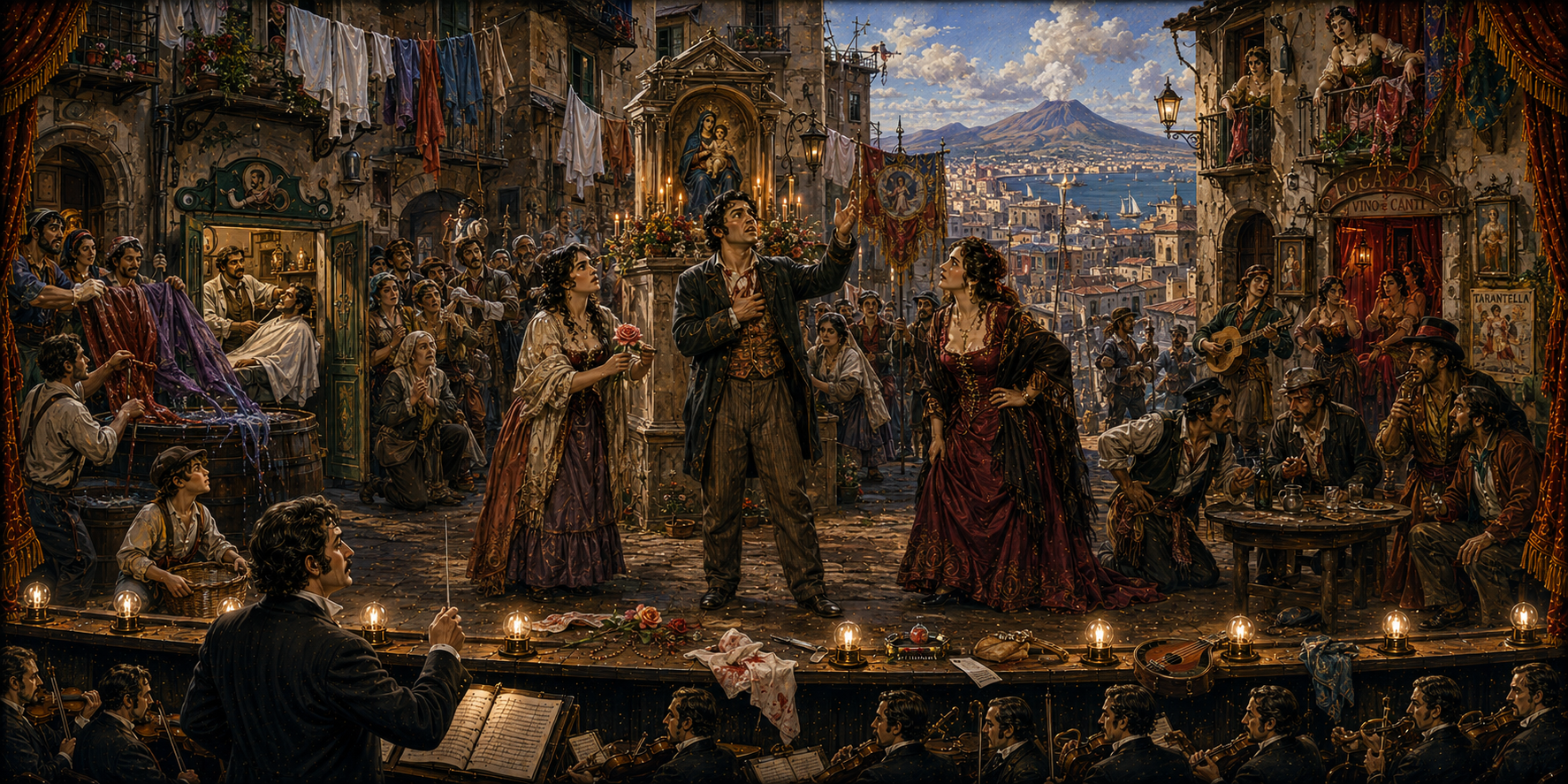

- Melodramma in 3 acts
- Composer: Umberto Giordano
- Libretto: Nicola Daspuro, after Salvatore Di Giacomo and Goffredo Cognetti’s Malavita
- First performed: Teatro Argentina, Rome, 21 February 1892, conducted by Vittorio Podesti
| VITO AMANTE | Tenor | Roberto Stagno |
| ANNETIELLO | Baritone | Ottorino Beltrami |
| CRISTINA | Soprano | Gemma Bellincioni |
| AMALIA, Annetiello’s wife | Mezzo | Emma Leonardi |
| MARCO, barber | Bass | Francesco Nicoletti |
| NUNZIA, hairdresser | Mezzo | Giulia Sporeni |
| Commoners, men and women, boys, dyers |
SETTING: Naples, circa 1810.
Verismo operas have the most unedifying plots, and Mala vita was verismo at its rawest: a melodrama set in the slums of Naples, where a young man with tuberculosis, coughing and spitting blood, vows to marry a prostitute if God will heal him; he falls back into the clutches of his mistress (a married woman, of course), and the unfortunate prostitute collapses on the steps of the brothel that will be her workplace for the rest of her short, miserable existence.
But then an opera called ‘Wretched Life’ was unlikely to end happily. In fact, Mala vita presents three wretched lives: the weak-willed consumptive Vito Amante (ironically meaning ‘Lover of Life’); his desperate mistress Amalia, scorned, dishonoured, and possessive; and the sympathetic prostitute Cristina whose hopes of love and a better life are dashed.
“In its merciless truthfulness to life, Mala vita is both gripping and revolting at the same time, like most of these realistic pieces,” the Viennese critic Eduard Hanslick thought.
Mala vita was Giordano’s first opera, commissioned after he entered Sonzogno’s competition for the best one-act opera. Giordano came sixth; Mascagni’s Cavalleria rusticana won. A success in Rome (24 curtain-calls), Mala vita flopped miserably in Naples, where audiences objected to its depiction of working-class morals. Giordano, fulminated contemporary critics, put “the pestilential slums of Naples onto the splendid stage of the San Carlo”.1
“From the beginning,” reported Neapolitan man of letters Eugenio Sacerdoti2 (Don Marzio), “the San Carlo was like a kennel of barking dogs. Most of the Neapolitan public felt that their moral values had been offended, forgetting that the same play, in prose, had been applauded throughout Italy and abroad as a lively, strong, depiction of local customs… My efforts to listen to the music were in vain; vulgar howling resounded ominously in the air all evening, like an insistent undertone of whistles and ocarinas.”
Outside Naples, Mala vita was performed in Germany and Vienna until 1894, then revised as Il voto in 1897; in that sanitised version, Cristina, no longer a prostitute, and drowns herself. The new version, according to Mallach, “sacrificed many of the original’s strengths without remedying its weaknesses”3; it disappeared from the stage in 1902.
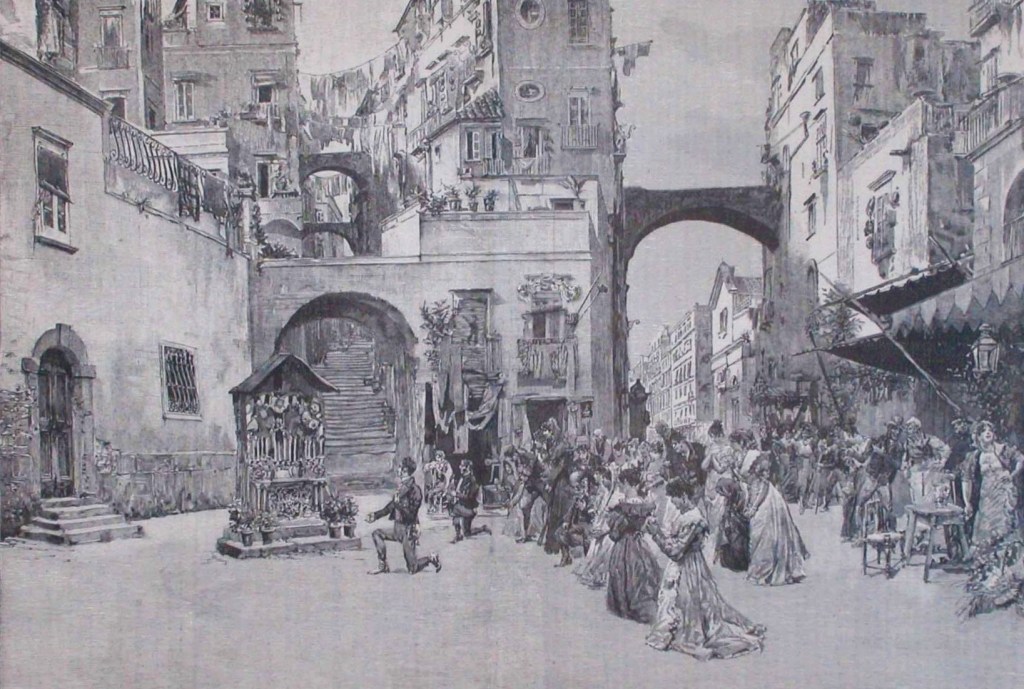
The characters are vividly drawn and the scenes dramatic, but the score is uneven. As Hanslick commented: “[Giordano’s] sense of drama is stronger than his musical talent, his temperament stronger than his artistry.” The orchestration is sometimes garish or clumsy (notably in the first scene), and some of the music (Vito’s Voto, the big prayer scene in Act I; the Intermezzo in Act II) are clearly modelled on Cav. Canzoni and duetti are marked in the contents, but the score flows continuously without formal breaks between numbers; Giordano’s score, however, is less through-composed and more tuneful than Cilea or Puccini’s scores. Vito sings duets with the good prostitute Cristina in Act I and with the demonic ‘respectable’ married woman in Act II. The former is uneven, but the andante mosso prelude, where Vito contemplates the rose Cristina has thrown him, and the allegro vivo section after Vito declares that he will save Cristina, are both effective; Saint-Saëns’s Samson et Dalila is allegedly the influence here. Act III provides Neapolitan local colour: a canzon d’amor (similar to ‘O sole mio’, written six years later), a tarantella, and another canzon; the lively choruses are rather better than the canzon itself.
Sordid though the story might be, at least Mala vita is never dull.
Recordings
Listen to: Maurizio Graziani (Vito), Massimo Simeoli (Annetiello), Paola Di Gregorio (Cristina), Maria Miccoli (Amalia), Antonio Rea (Marco), and Tiziana Portoghese (Nunzia), with the Orchestra Lirico Sinfonica del Teatro della Capitanata, conducted by Angelo Cavallaro; Foggia, 2002; Bongiovanni.
 OPERA UNLEASHED!
Hmmmm.. 3 stars from you? Now I’m intrigued by it.
LikeLike