
Licht: Die sieben Tage der Woche
- Cycle of 7 operas
- Composer and librettist: Karlheinz Stockhausen
- First performed: 1981 to 2012
Star rating: Sirius. (Terrestrial norms do not apply.)
Licht is the most extraordinary operatic project ever conceived: a 29-hour cosmological cycle written by modern music’s answer to Ziggy Stardust: an extraterrestrial guru (from a small planet somewhere in the vicinity of Sirius, or possibly western Germany) who wanted to usher in a new age of peace and harmony through music. Wagner’s Ring isn’t even on the same page. Its only rival for sheer grandiosity is Scriabin’s attempt to end the world.
Stockhausen (1928–2007) has been called one of the most important composers in Western music: “the father of electronic music”, he was a pioneering technician who “invented new sounds and new ways of putting sounds together”: previously unheard-of textures, layers of sound, and surround sound.1 Stockhausen started as a strict serialist in the Boulez manner, but his music was revolutionary; where Boulez and co. stayed in the ivory tower, arranging numbers on graph paper, patting themselves on the back for their soulless precision, Stockhausen built a rocket ship and invited listeners along for the ride: “Are these guys boring you? Why don’t you talk to me instead? I’m from a different planet.”
His electronic soundscapes were hypnotic and otherworldly, evoking cosmic landscapes beyond the void and untravelled vistas of sound at the edges of perception. It’s almost obligatory to mention that the Beatles were fans (he’s on the cover of Sgt. Pepper). So were Pink Floyd. So was the BBC Radiophonic Workshop; I was born in the early 1980s, so I was immersed in the Stockhausen style, watching Doctor Who: the hisses and howls, the vworps and worbles, the beeps and burbles, the modulators, tape manipulation and oscillators. Listen to Tristram Cary’s metal jungles of Skaro, to Malcolm Clarke’s Sea Devils, or indeed Delia Derbyshire’s theme itself.
The creation of Licht occupied the last three decades of Stockhausen’s life. It consists of seven operas, named after the days of the week:
- Donnerstag (La Scala, Milan, 15 March 1981): day of Michael
- Samstag (La Scala, Milan, 25 May 1984): day of Lucifer
- Monntag (La Scala, Milan, 7 May 1988): day of Eve
- Dienstag (Leipzig, 28 May 1993): conflict between Michael and Lucifer
- Freitag (Leipzig, 12 September 1996): Lucifer’s temptation of Eve
- Mittwoch (Birmingham, 22 August 2012): co-operation and reconciliation of Michael, Eve, Lucifer
- Sonntag (Cologne, 9 April 2011): Michael and Eve’s mystical union
“There is neither end nor beginning to the week. It is an eternal spiral.”
Michael (the Creator-Angel of the universe) and Eve (the primal mother, embodying fertility) are opposed by Lucifer (their adversary). Michael (tenor) is associated with the trumpet; Eve (soprano) with the basset-horn; and Lucifer (bass) with the trombone. The entire cycle is based on a one-minute superformula representing those characters: a 13-note Michael formula, a 12-note Eve formula, and an 11-note Lucifer formula.
“Various spiritual currents can come together in my work: it is a real dramatic arena,” Stockhausen explained.2 “For me it is terribly important that this balance continues to exist — that the constructive forces of progress continue for the benefit of human creation and the human world, ever mindful of all the essential yet questionable aspects of this process.”
I shan’t even attempt to review Licht; I’ve listened to much of the music — the ambient soundscapes, the rhythmic chanting, the army of modulators and synths, the choruses in world languages and made-up ones, the kookaburras, splashing water and barking dogs, invocations of goddesses, “Invasion-Explosions”, the Greetings, Dances and Farewells. It is wild, out-there stuff.
But the music is only part of Licht. Licht is a modern art installation; it’s the apotheosis of prog rock; it’s a concept album; it’s far-fetched fiction; it’s an event, a happening, an experience.
And spectacle is crucial. Take Michaels Reise um die Erde (“Michael’s Trip Around the World”), the trumpet concerto from Donnerstag, for instance. I watched the 2018 Le Balcon minimalist production: it’s cool jazz, but to watch, it’s just one bloke (in jeans and a shirt) walking around the orchestra pit playing a trumpet. Stockhausen Lite isn’t Stockhausen. THIS is how it should be: trippy to the max.
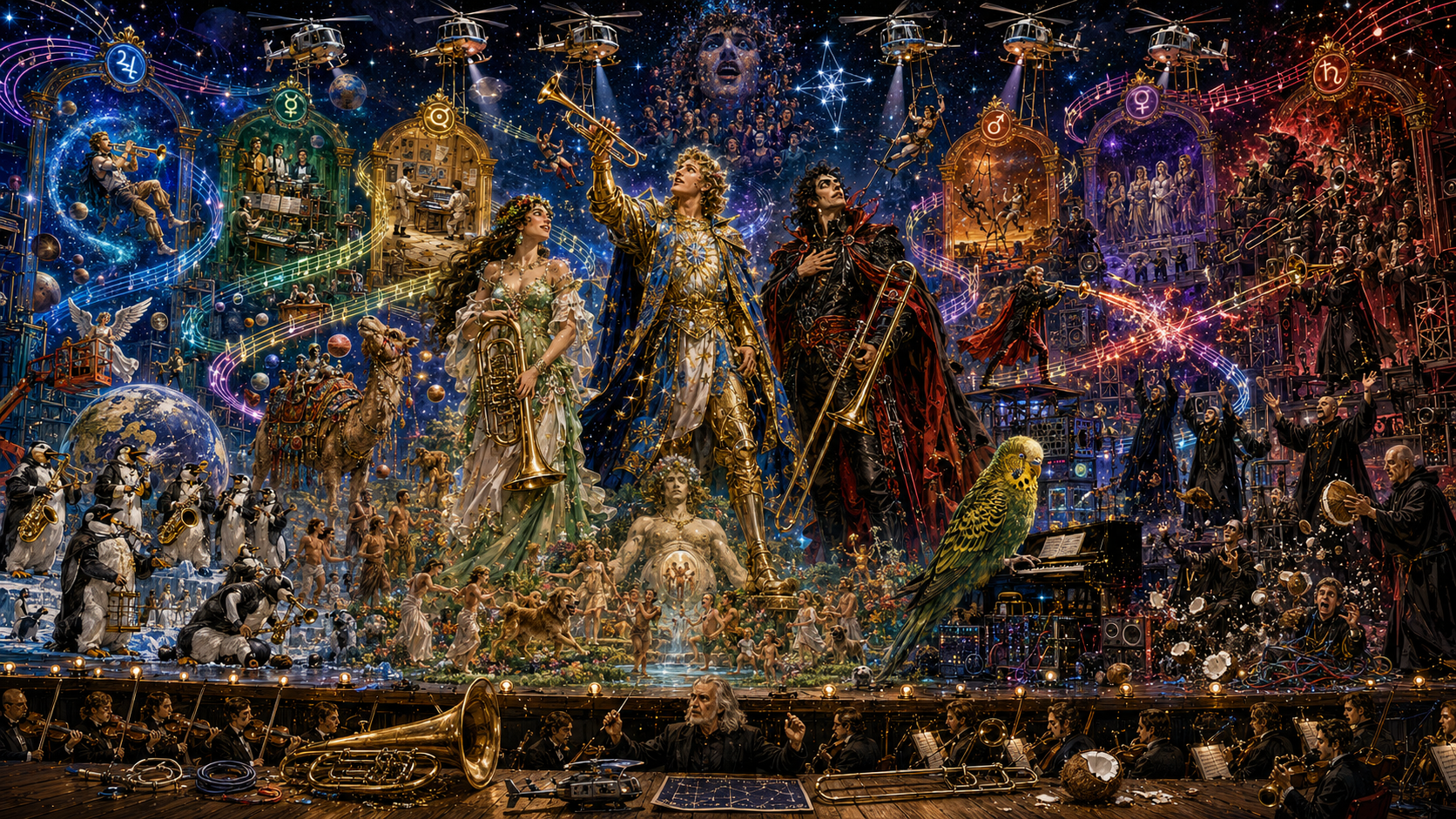
Son et lumière. Tendrils of light. Enormous blue discs. Alien angels riding cherry pickers. The stage is on fire. CSO aeroplanes zoom into video screens. Psychedelic trips through the solar system and through skeletons. Giant skulls turn into valleys of enormous bosoms. And the orchestra dressed as penguins. Well, that was COOL.
As the man himself said: “I don’t need an orchestra pit anymore. Only in the very beginning I had an orchestra in Donnerstag, but even then in the second act they are all penguins sitting at the South Pole under an enormous globe.” (That might be one of the most hilarious non-sequituur sentences ever.)
Trying to review Licht without seeing it would be like “listening” to Cirque du Soleil. I want to see the camel from outer space that poops planets, is elected president of the galaxy, and turns into a Zen monk. The piano-playing giant budgerigar that fertilises the huge statue of a naked woman giving birth to mankind. The octophonic battle between armies of musicians trying to control time. The alien monster playing the synthesiser. The giant face made up of dancing musicians. The orchestra hanging from the trapeze. The pencil man pushing himself into a four-metre-high pencil sharpener, and the people copulating with photocopiers. The flute-playing cat and the fire-breathing rhinoceros. The exorcism conducted by coconut-smashing monks. And, of course, the helicopter quartet.
One YouTuber commented: “Good thing Stockhausen didn’t write a Skydiving Quartet.”
Seeing Licht in the theatre — better still, on a space station or the dark side of the moon — would be awesome. Licht would be a mind-blowing, mind-expanding (and deeply weird or silly) experience. But (the devil whispers) is it opera?
As the Stockhausen: Sounds in Space website says, Licht is a cycle of “thematically-linked, evening-length productions featuring electro-acoustic concert works driven by semi-narrative vocal elements […] These staged productions have almost nothing in common with most traditional operas written in the last 250 years.” There is little narrative in the conventional sense; indeed, Licht is made up of units that can be performed independently. There is little characterisation: the melodies themselves are characters; they represent cosmic figures, ideas, archetypes and symbols. There are no tunes for the people to hum. It bears no resemblance to music drama as Verdi, Puccini or even Wagner envisaged it.
And it’s borderline unperformable: Stockhausen demanded new venues (an auditorium should be specially built for Freitag); all seven operas have never been performed together (the closest anyone has come was three days of excerpts in the Netherlands); productions have bankrupted companies (Sonntag, 2011); while opposition from the Austrian Greens to the helicopter quartet resulted in the cancellation of Mittwoch’s intended première.
What (the masses might ask) the *#%! has gone wrong with 20th-century opera? What happened to all those romantic operas with heart and big tunes? Where did they go?
- See, for instance, Robert Worby, “Stockhausen: The Father of Electronic Music”, 2017, https://www.barbican.org.uk/s/stockhausen. ↩︎
- Quoted in Michael Kurtz, Stockhausen: A Biography, 1988,trans. Michael Kurtz, London: Faber & Faber, 1992, p. 210. ↩︎
 OPERA UNLEASHED!
To avoid confusion, it is worth mentioning that there are three formulas for each of the characters, the central tones (with the 13 + 12 + 11 tones), the nuclear formula, and the superformula. (Also Stockhausen is actually from Sirius the star, not a nearby planet, as he has said that it is possible to walk on Sirius.)
LikeLike