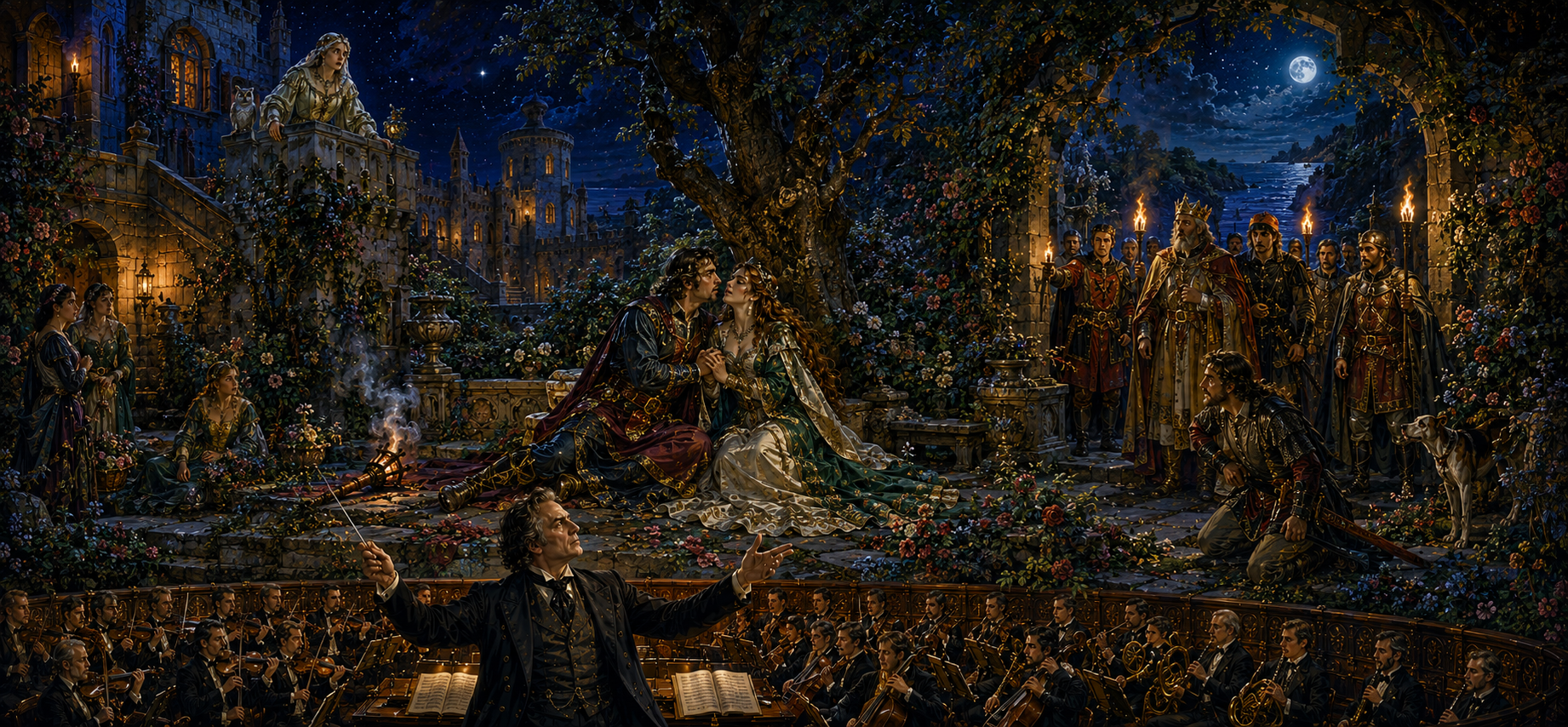

- Music drama in 3 acts
- Composer and libretto: Richard Wagner
- First performed: Königliches Hof- und Nationaltheater, Munich, Germany, 10th June 1865
| TRISTAN A Breton nobleman, adopted heir of Marke | Tenor | Ludwig Schnorr von Carolsfeld |
| ISOLDE An Irish princess betrothed to Marke | High dramatic soprano | Malvina Schnorr von Carolsfeld |
| BRANGÄNE Isolde’s maid | Soprano | Anna Deinet |
| KURWENAL Tristan’s servant | Baritone | Anton Mitterwurzer |
| MARKE King of Cornwall | Bass | Ludwig Zottmayr |
| MELOT A courtier, Tristan’s friend | Tenor | Karl Samuel Heinrich |
| A shepherd | Tenor | Karl Simons |
| A steersman | Baritone | Peter Hartmann |
| A young sailor | Tenor | |
| Sailors, knights, and esquires |
“Seeing Tristan is a once in a lifetime thing,” my companion said as we stumbled out into the daylight after seeing the 2016 Rome broadcast. (Wonderful Day! Sunlight, warmth!) “I never want to hear it again in my life.”
He has a point.
Tristan and Isolde’s ambition in life is to die. Only in death, they believe, can they consummate their love. The problem with being dead is, you’re dead. That makes consummating your love awfully hard. (And things that should be awfully hard if love is to be consummated have started to decompose.) The grave’s a fine and private place, but none, I think, do there embrace. Dead people don’t roll around the crypt, having hot dead sex; they lie there and rot. Still, whatever makes them happy.
They don’t have free will; they drink a magic potion which makes them fall in love (a sort of mediaeval oxytocin). Under its influence, they express their feelings in the sort of gushing, perfumed prose that would make Barbara Cartland blench.
“How our hearts are borne aloft! How all our senses pulsate with bliss! Longing devotion’s burgeoning blossoms, yearning love’s blessed glow! My heart bursting with exultant delight! Isolde! Tristan! Broken free of the world, won for me! You my only awareness, utmost rapture of love!”
In Act II, they expound their philosophy of life in a gargantuan love duet. I say “love duet”; Tristan and Isolde sing abstract nouns at each other, and regurgitate undigested and indigestible bits of Schopenhauer. Granted, “O sink hernieder”1 is lovely to hear – but what lyrics! They start as high-flown gibberish and descend into a dream of narcissistic death. Here are some of the juicy bits:
I: For how long away! Away for so long!
T: How far yet so near! So near yet how far!
I: O enemy of friends, evil distance! Drawn-out time’s lingering expanse!
T: O distance and nearness, sternly parted! Sweet nearness! Desolate distance!
I: You in darkness, I in light!
I: There to pledge to you eternal love, to consecrate you to Death in company with myself
T: Through Death’s portals wide and open it flowed towards me, opening up the wondrous realm of Night, where I had only been in dreams. From the image in my heart’s sheltering cell it repelled day’s deceiving beams, so that in darkness my eyes might serve to see it clearly.
TOGETHER: Descend O Night of love, grant oblivion that I may live; take me up into your bosom, release me from the world!
T: Let Day give way before death! (Laß den Tag dem Tode weichen!)
T: Thus might we die, that together, ever one, without end, never waking, never fearing, namelessly enveloped in love, given up to each other, to live only for love!
…
I (dreamily) Let me die! (Laß mich sterben!)
TOGETHER: O eternal Night, sweet Night! Gloriously sublime Night of love! Those whom you have embraced, upon whom you have smiled, how could they ever waken without fear? Now banish dread, sweet death, yearned for, long for death-in-love! In your arms, consecrated to you, sacred elemental quickening force, free from the peril of waking!
TOGETHER: Ever endless self-knowing; warmly glowing heart, love’s utmost joy!2
That’s true love right there. None of this sentimental nonsense about wanting to live happily ever after (or a reasonable facsimile thereof), but a healthy, robust drive towards death. If only they’d died in the first act, they’d have made themselves much happier – and the audience too.
That act, my friend said, reminded him of why he stopped reading mediaeval literature. “Everything is an allegory, and a clumsy, clod-hopping one at that.”
He has a point. Day, Wagner tells us, is deceitful and false, because it’s the realm of the real world (which is an illusion); Night is true, because it’s the realm of death and oblivion.
Wagner wrote: “Thanks to the potion, the passion of Tristan and Isolde suddenly flares up and they have to confess mutually that they belong only to each other. And now there are no bounds to the longing, the desire, the bliss and the anguish of love. The world, power, fame, glory, honour, chivalry, loyalty, friendship are all swept away like chaff, an empty dream. Only one thing is left alive: yearning, yearning, insatiable desire, ever reborn – languishing and thirsting; the sole release—death, dying, extinction, never more to awaken! … Is it the bliss of renouncing life, of being no more, of a last redemption into that wondrous realm from which we stray the furthest when we strive to enter it by force. Shall we call it death? Or is it not the wondrous world of night, whence—so the story goes—an ivy and a vine sprang up in locked embrace over the grave of Tristan and Isolde?”
Which may be all very well if one agrees with Schopenhauer; I don’t. (Life is suffering? We live in the worst of all possible worlds? Happiness is merely the absence of pain, frustration, and dissatisfaction? Twaddle!)
“Wagner’s problem,” says my friend, “is that he never grew up. It’s adolescent. It’s the pretentious, pseudo-philosophy of a 15-year-old.”
Unfortunately, in Act III Tristan’s still not dead. Oh, he’s yearning for “divine, eternal, utter oblivion”, but he’s still in the world of the living. That makes him unhappy, as he tells the audience at great length.
“Yearning! Yearning! While dying yearn, but not to die of yearning! Never dying, yearning, calling out for the peace of death to the far-away physician.”3
It’s like being collared by a drunk who wants to pour out his litany of woe into your ear. “I’ve had an awful life, me. My mum died when I was born, and things have gone downhill ever since.” (Presumably the bandaged form on his roof is his mummy.)
Then comes the good news: Isolde is on her way to heal his wounds. Joy and rapture! He’s so excited he tears open his wound, and staggers about the stage, spurting blood all over the place.
“With bleeding wound I once battled with Morold, with bleeding wound I now pursue Isolde! (Tears the dressing from his wound.) Ah, my blood! Cheerily flow, my blood! She who my wound will finally heal, like a hero approaches, she approaches, my salvation! Let the world perish before my rejoicing haste!”
His corpuscles are strewn across the stage, but he lasts long enough to die in Isolde’s arms. Isolde is distraught.
“May I not utter my lament to you? Just once, ah! Just once more!” Isolde says towards the end of Act III. Utter her lament? Just once? She’s been doing nothing else all the opera.
Ah, but at least there’s the Liebestod, Hollywood’s favorite go-to piece for tragic love. It’s a wonderful piece of music. I never realized how wonderful until I sat through the whole opera. It means the end of the wretched thing. Five hours of unrelieved angst, with half an hour of music and long stretches of arid tunelessness. No wonder Wagner had trouble getting his operas (I beg his pardon, “music dramas”) put on!
Look at the lyrics of the Liebestod.
“Are they gentle aerial waves ringing out clearly, surging around me? Are they billows of blissful fragrance? As they seethe and roar about me, shall I breathe, shall I give ear! Shall I drink of them, plunge beneath them? Breathe my life away in sweet scents? In the heaving swell, in the resounding echoes, in the universal stream of the world-breath – to drown, to founder – unconscious – utmost rapture!”
Utmost nonsense. What exactly is “the universal stream of the world-breath”? Does it take mints for halitosis? Is it driven by convection currents? And do “gentle aerial waves” give good reception?
Still more people die, although they don’t seem to be very happy about it: Tristan and Isolde’s servants, a wicked courtier named Melot, and a whole host of supers. At the end, there are even more bodies onstage than at the end of Hamlet. This is a tragedy, and the more corpses the more tragic. Yes, my heart was broken when Non-Speaking Soldier Second on the Right was stabbed in the brisket.
Wagner wrote a youthful tragedy in which so many characters snuffed it he had to bring them back as ghosts. We’re spared Tristan and Isolde’s spectral apparition.
Later this year my friend is going to hear Jonas Kaufmann in a concert performance of Parsifal. He’s now having second thoughts. “It would be wonderful to hear Kaufmann, of course, but is it worth sitting through more Wagner?”
At the café I went to later, they placed Otello’s farewell to arms; the Triumphal March from Aida; Beethoven’s Ninth; and one of Mozart’s piano concerti. I’d forgotten what music sounded like.
Nietzsche suggested Bizet’s Carmen as an antidote to Wagner. My friend suggests Mozart or Strauss, sophisticated and grown-up composers. Who else – the worldly wit of Rossini or Offenbach? the Shakespearean compassion of Verdi?
There’s one opera that I would put in direct opposition to Tristan – an opera which loves life as that morbid, solipsistic work longs for death. An opera that puts into practice Hugo’s belief that theatre must depict the world in all its rich variety: the ugly and the beautiful, the grotesque and the sublime. It’s a historical opera that mixes comedy and tragedy, high-born and low-born characters, and whose score bursts with dizzying invention. It has massive crowd scenes, trios, swordfights, bel canto arias, pastorale scenes, dances, lovers’ duets, and a boy played by a girl. And it was produced in Paris in the 1830s.
I mean, of course, Berlioz’s Benvenuto Cellini.
- Lit. “There’s a sink down here.” Tristan’s concern with his plumbing explains why he spends more time talking than doing (or screwing). ↩︎
- Opera Roma’s synopsis (http://www.operaroma.it/en/shows/tristan-und-isolde/) refers to:
“a song of praise to the night – the kingdom of nothingness and of love, contrasting with the hostile, faithless day”
“eternal joy in the sphere of darkness and nothingness”
“The duet consists largely of detached ejaculations and verbal plays, each paraphrasing or varying or giving a new turn to the outpouring of the other, the whole permeated with the symbolism of pessimistic philosophy in which night, death, and oblivion are glorified, and day, life, and memory contemned.” (http://www.danielmcadam.com/tristan-isolde.html)
Wow, sounds fun! Let’s glorify death and oblivion, and condemn life. ↩︎ - I’m irresistibly reminded of Patience:
BUNTHORNE: Life is made up of interruptions. The tortured soul, yearning for solitude, writhes under them. Oh, but my heart is a-weary! Oh, I am a cursed thing! – Don’t go. Tell me, girl, do you ever yearn?
PATIENCE: I earn my living.
BUNTHORNE: No, no! Do you know what it is to be heart-hungry? Do you know what it is to yearn for the Indefinable, and yet to be brought face to face, daily, with the Multiplication Table? Do you know what it is to seek oceans and to find puddles? to long for whirlwinds and yet have to do the best you can with the bellows? That’s my case. Oh, I am a cursed thing! – Don’t go. … What’s the use of yearning for Elysian fields when you know you can’t get ’em, and would only let ’em out on building leases if you had ’em? ↩︎

