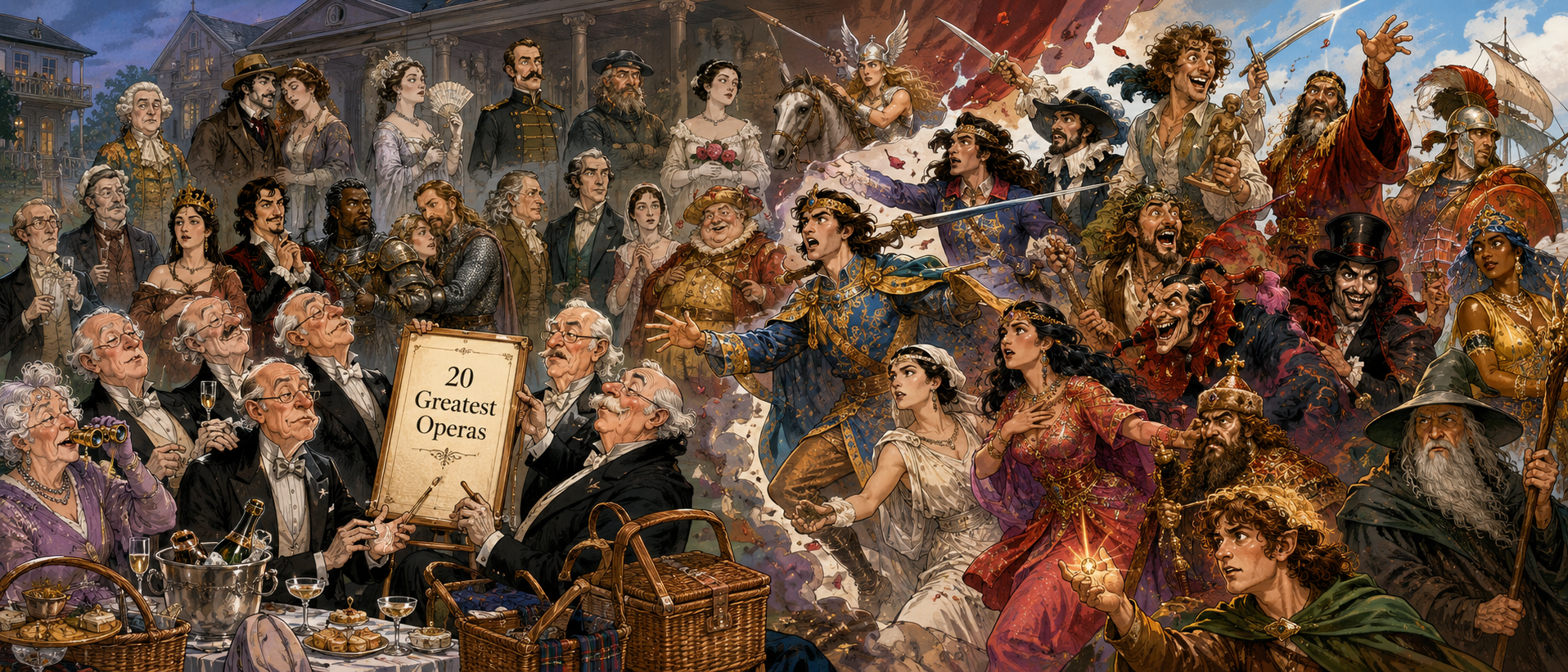

BBC Music Magazine reshared its list of 20 greatest operas of all time on Facebook.
- Mozart: The Marriage of Figaro
- Puccini: La Bohème
- Strauss: Der Rosenkavalier
- Berg: Wozzeck
- Britten: Peter Grimes
- Puccini: Tosca
- Monteverdi: L’incoronazione di Poppea
- Mozart: Don Giovanni
- Verdi: Otello
- Wagner: Tristan und Isolde
- Debussy: Pelléas et Mélisande
- Verdi: La Traviata
- Tchaikovsky: Eugene Onegin
- Janáček: Jenůfa
- Verdi: Don Carlos
- Wagner: Die Meistersinger von Nürnberg
- Monteverdi: L’Orfeo
- Verdi: Falstaff
- Handel: Giulio Cesare
- Wagner: Die Walküre
This list is a model of frozen, respectable Anglo good taste, the Glyndebourne mentality circa 1960.
Whoever wrote this list seems unaware of:
a) the Baroque rediscovery — not just Handel, but Vinci, Vivaldi, Porpora etc.
b) the bel canto rediscovery (including the excellent work done in the UK itself by Opera Rara)
c) the rediscovery of French opera championed by Bru Zane
d) opera from outside Italy, France, and Germany (Peter Grimes aside)
It’s a list of operas whose values are often oddly unoperatic.
Opera was the blockbuster before cinema; fantasy and epic before Tolkien and Game of Thrones; and heavy metal long before the electric guitar.
It was THE dramatic form of the 19th century: both pop culture and high art, thrilling and politically charged, adored by rich and poor alike. It was meant to thrill, amaze, and astound, to keep audiences on the edge of their seats, and to make them “weep, shudder, and die” through singing, sensational storylines, and special effects. (See here.)
Opera depicted revolution, religious fanaticism, and class conflict. Peoples fighting for their liberty. Oppressive régimes overthrown. Empires built. Battles, curses, family feuds, revenge, and love betrayed. Heaven and hell. Vampires, gods, demons, sorcerers, witches – and the occasional dragon. Violent passion and even more violent death.
Opera inspired and terrified. It was banned and censored, and sparked uprisings that brought down governments and created nations.
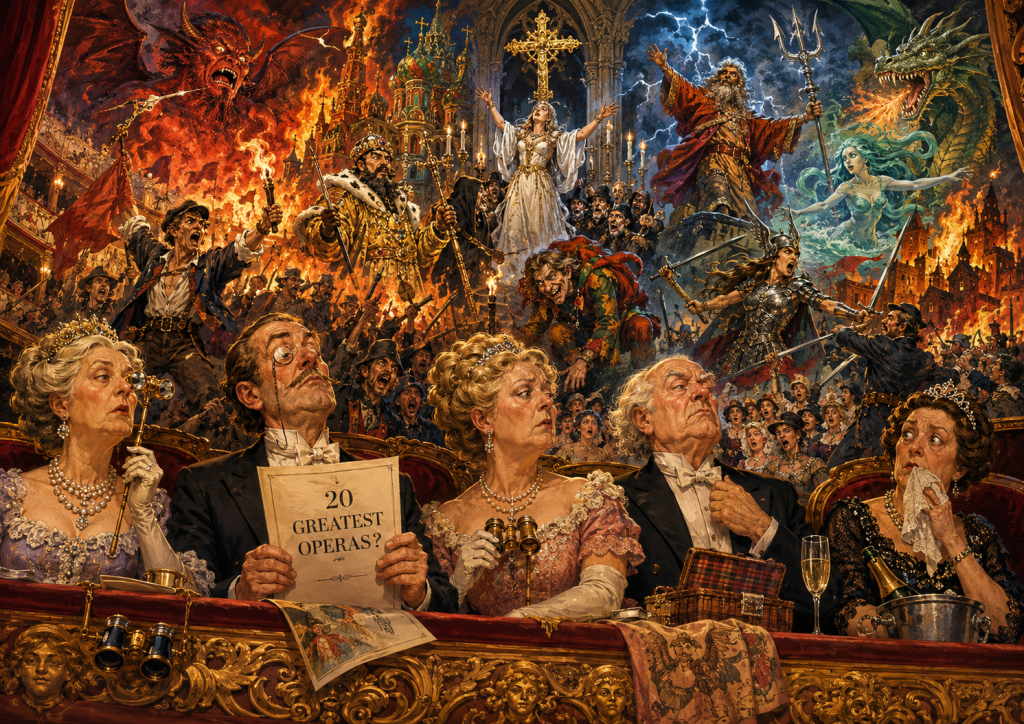
Of the 20 works on the BBC’s list, only Don Carlos and Otello — perhaps Tosca (at least the Te Deum) — would set the stage on fire.
Otherwise, the list leans towards comedy of manners, Modernism, misty Symbolist half-tones, and small-scale naturalism.
The epic, the historical, the heroic? Excitement, passion, spectacle, melodrama? AWOL.
Mozart at the top. Three Wagners. Two Monteverdis. Peter Grimes, of all things, at number five, in a show of British parochialism. Verdi only comes in at number nine — and then “respectable” late Verdi. Where, one might well ask, are Rigoletto and Trovatore, or Aida? And surely Carmen, Lucia di Lammermoor, and The Barber of Seville ought to be on the list?
Most of these — L’Orfeo, Giulio Cesare, Figaro, Traviata, Falstaff, the Wagners, Onegin, Bohème, Pelléas, Jenůfa, Rosenkavalier, Wozzeck, Peter Grimes — wouldn’t feature on my top 20 list. Some of them aren’t even their composers’ best works; several of them I heartily dislike.
Orleanskaya deva instead of Onegin, please. Salome and Elektra are better drama than Rosenkavalier, while Die schweigsame Frau is better comedy. The magnificent first two acts of Turandot easily overshadow Bohème’s tubercular garret sentiment. And Billy Budd or Midsummer Night’s Dream rather than Grimes.
In fact, my list would look very different. Of the BBC’s choices, only Don Carlos and Otello would be on there. But it would include:
- Artaserse (Vinci, 1730)
- Hippolyte et Aricie (Rameau, 1733)
- Iphigénie en Tauride (Gluck, 1779)
- Either, or perhaps both, Tarare and Les Danaïdes (Salieri)
- La Juive (Halévy, 1835)
- Les Huguenots (Meyerbeer, 1836)
- Benvenuto Cellini (Berlioz, 1838)
- Orazi e Curiazi (Mercadante, 1846)
- Le Prophète (Meyerbeer, 1849)
- Rigoletto (Verdi, 1851)
- Les Troyens (Berlioz, 1856-58)
- Faust (Gounod, 1859)
- L’africaine [Vasco de Gama] (Meyerbeer, 1865)
- Boris Godunov (Mussorgsky, 1874)
- The Lord of the Rings (Paul Corfield Godfrey, 2025)
Among comedies: the complete works of Offenbach (Ba-ta-clan! Croquefer! M. Choufleuri! Les Brigands!) and Moniuszko’s Straszny dwór.
And if Pacini’s Lorenzino de’ Medici, Don Diego de’ Mendoza, Berta di Varnol and Niccolò dei Lapi were revived, I warrant they’d be on that list too.
The BBC list gives us opera as culture. I want opera as theatre. I want the life-force.
Or as D. H. Lawrence said: “I love Italian opera – it’s so reckless. Damn Wagner, and his bellowings at Fate and death.”
 OPERA UNLEASHED!
100 percent agree. Your list would be much closer to mine!
LikeLike
What’s your list, Brendan?
LikeLike