
By the late twentieth century, opera, as we have seen, was dead — or, at best, unrecognisable. True: La Scala, Paris, and the Met performed opera to sold-out houses every year. Singers like Domingo, Pavarotti, Carreras and Joan Sutherland were world-famous. Dozens of operas were recorded, many for the first time — the Rossini revival in particular was underway. But as far as the public was concerned, opera might have died with Puccini and Turandot.
Contemporary composers, however, relegated Puccini and all that came before him to the dustbin of history; their motto, in Boulez’s words, was “to blow the opera houses up” — and to hell with Gluck and Handel. No self-respecting modernist would have written an opera in the traditional style:
For many ‘serious’ European composers born in the earlier decades of the twentieth century, the idea of writing grand opera was only to be confronted with distaste, if not representing outright anathema. After all, one thing the Second World War was meant to have burned from the playbook was allegiance to regressive bourgeois genres.1
Instead, their models were Berg’s Wozzeck and Lulu, “justifying dissonances of harmony and style by extremes of emotion and violent changes of mood”.2 Their operas were atonal and alienating, created (like so much modern art) by practitioners for fellow practitioners and critics, not for amateurs of the artform.
Had, say, Mozart or Verdi been forced to watch Die Soldaten, Punch and Judy or Die Teufel von Loudun, they would have been shocked. Where (they might have asked) had the beauty of opera gone? Why was the music wilfully ugly? Why were the stories so bleak and violent? Offenbach might have been nonplussed by Le Grand Macabre: it is supposedly black comedy, and its tinpot kingdom of Brueghelland is practically next door to Gerolstein, but where was the mirth, let alone the tunes? Even Wagner might have thought that Stockhausen had taken his advice — “Kinder! Macht Neues!” — far too far in the cosmic madness of Licht, with its intergalactic planet-defecating camels and penguin orchestras. (He would probably have wanted helicopters for the Ride of the Valkyries, though.)
Many contemporary operas, while praised by the critics, failed to win over the public. Audiences, after all, had never gone to opera for atonality, abstraction and alienation; what they delighted in was something to feel (drama, strong passions, sentiment and weeping, a thrill, comedy); something to look at (spectacle); and, above all, something to hear (melody).
But where did that sort of entertainment go? And where did opera go?
It went … HERE.
Raise the chandelier!
The Phantom of the Opera (Andrew Lloyd Webber)
- Musical in 3 acts
- Composer: Andrew Lloyd Webber
- Book: Richard Stilgoe & Andrew Lloyd Webber. Lyrics: Charles Hart & Richard Stilgoe.
- First performed: Her Majesty’s Theatre, London, 9th October 1986
| THE PHANTOM OF THE OPERA | Michael Crawford | |
| CHRISTINE DAAÉ | Soprano | Sarah Brightman |
| RAOUL, Vicomte de Chagny | Steve Barton | |
| Monsieur Gilles ANDRÉ | David Firth | |
| Monsieur Richard FIRMIN | John Savident | |
| CARLOTTA Guidicelli | Rosemary Ashe | |
| MADAME GIRY | Mary Millar | |
| MEG GIRY | Janet Devenish | |
| Ubaldo PIANGI | John Aron |
SETTING: The Opéra Populaire, Paris, 1881.
“The Phantom of the Opera — one of the most successful musicals in the world — an opera?!” I hear you splutter.
No, of course it isn’t, but it is far more operatic than most operas produced at the time, and indeed closer to opera than it is to the musicals of Rodgers & Hammerstein or Stephen Sondheim.
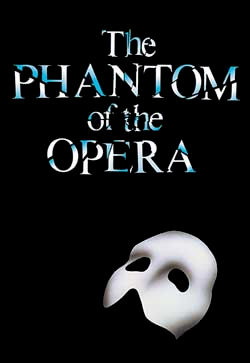
Phantom is the ghost of operas past, risen from the grave, like Hamlet senior, to confront the present. It opens amidst the debris of opera: the Opéra Populaire (popular opera, opera for the people) has closed, and its contents are being auctioned off; the great works of the past — such as Meyerbeer’s epochal monumental Robert le Diable (1831) — have been reduced to a few tawdry relics: a wooden pistol and three skulls, sold for 15 francs.
The rest of the musical looks back at what opera was. Opera, Phantom suggests, is “an exotic and irrational entertainment”, preposterous stories sung by fat Italian sopranos and tenors — unlike the beautiful people who perform musical theatre, which is engaging and demotic. Phantom sums up the last two centuries of opera: the Opéra Populaire stages pastiche opera buffa (specifically Mozart’s Figaro¸ in the form of Il Muto: countess cheats on her husband with transvestite pageboy, recitativo secco) and French grand opéra (“Chalumeau’s” Hannibal, apparently parodying Meyerbeer, but more like Handel, Spontini or Reyer: a stage awash with pyramids and animal-headed statues, ballet). There are little clins d’œils to opera fans: anachronistic posters of Massenet’s Le Mage, Février’s Monna Vanna (!), and Rabaud’s Mârouf, savetier du Caire adorn the theatre managers’ office.
The Phantom’s Don Juan Triumphant is a hilarious parody of dissonant avant-garde opera: the composer thinks himself a genius and holds the opera house hostage to have his self-evidently awful opera performed; nobody wants to hear it; the singers find it unsingable; the composer casually murders the tenor; and it ends with the forcible vanishment of the prima donna. (The discordant trumpet even sounds like Punch and Judy!) “See,” Lloyd Webber might well be saying, “this is what opera turned into! This is why audiences left the opera house and came here instead.”
As well as criticising what opera had become, Lloyd Webber lays claim to what opera was. Hearing Tosca as an adolescent made him a lifelong devotee and emulator (occasional plagiarist) of Puccini; he understood the power of opera. In Phantom, Lloyd Webber gave the public what they craved, and what opera had lacked for decades: audience-friendly, lushly melodic, dramatically direct, and unashamedly theatrical entertainment. It was musical theatre for the kind of audiences that used to go to the opera in the 19th century; meanwhile, 1980s opera audiences got Harrison Birtwistle. Opera audiences didn’t leave opera; opera left them.
Phantom serves up a conflicted love triangle; spectacle (a boat ride across an underground lake, the famous stage effect of the falling chandelier); unforgettable Big Tunes that bypass the brain and go straight from the ears to the gut; and lush late Romantic orchestration, sprinkled with enough rock, electric guitars and atonalism to say “This is twentieth century music”. Lloyd Webber writes modern, slightly poppified versions of opera numbers: the prima donna’s aria (“Think of Me”, ending in a cadenza; “Wishing You Were Somehow Here Again”); the confusion scene and concertato ensemble (the marvellous “Prima Donna”); the love duet (“All I Ask of You”) — there are few love duets in 1980s opera; the big song and dance number (“Maskerade”), a direct descendant of the ballet scene in Auber‘s Gustave III. Meanwhile, there are echoes of Stravinsky and Bergian Sprechgesang in the Phantom’s music.
Phantom, as I said above, is musical theatre, not opera — and yet: if you squint at it, what’s the difference? A lot of 18th and 19th century opera was musical theatre in format: spoken dialogue plus singing (opéra-comique, Singspiel) — and plenty of opéras-comiques, for instance, written for a notoriously unmusical public, are much less sophisticated musically than Phantom. Composers like Kurt Weill and Leonard Bernstein wrote both operas and Broadway musicals. What exactly are Candide and West Side Story — which has been sung by Kiri Te Kanawa and José Carreras? (Further blurring the lines, Carreras recorded an album of Lloyd Webber songs.) Meanwhile, Sondheim’s musicals —A Little Night Music and Sweeney Todd — are performed in opera houses, and sung by Bryn Terfel. Sondheim said that whether a work was an opera or a musical depended on where it was put on.
Opera Australia produced Phantom at the Sydney Opera House in 2022. Case proved.
 The Opera Scribe
Seriously ballsy Mr Fuller. Hats off.
LikeLiked by 1 person
One more thing to add! I was once in the company of a gaggle of opera queens, venom dripping from their fangs. They were bitching about how awful they thought Phantom was, and that Andrew Lloyd Webber was a hack, blah blah blah. The same sort of people who hate John Rutter and Eric Whitacre. I left, due to the lack of oxygen. Out in the fresh air, I had to look up ALW. He’s worth a billion dollars. I thought, “he’s doing something right.” Really, I can’t argue with a billion dollars. Cheers, Mr. Lloyd Webber.
LikeLike
Nothing offends like success? 😉
LikeLike